One would think that Time could afford to hire a reporter capable of uncovering a different angle, or talking to people who haven’t been interviewed several times over by NPR or CBS.
If you want some laughter therapy, read the full story here. But if your Time is more valuable, here are the hilarious highlights:
“a squatters’ camp deep in the badlands of California’s poorest county, where the road ends”
“dropouts and fugitives of all stripes”
“recession refugees”
“a former drug addict turned born-again Christian”
“tribes have emerged”
“soul-searching Gypsy Kids who arrive by train with little more than the ragged clothes on their back”
“the rowdy bikers who pass through, or the meth-addled loners on the outer edges inclined to greet a trespasser with a gunshot”
“disappearances, mysterious drownings in the mud baths, the man who showed up in camp with his finger apparently bitten off”
“The border patrol keeps a visible presence, searching for illegal immigrants that ply the region.”
Yeah, that pretty much sums up most of us, like Jim and I, or our super friendly, squeaky clean neighbors, the Bayfield Bunch, or the Canadian politician who was here last week.
Can you say “Sensationalism”? Remember kids, The Media Lies.
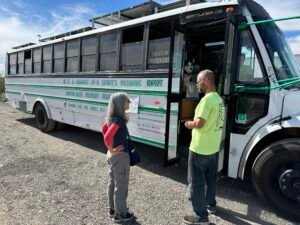
The Slabs are a hotbed of serendipitous blogger meet-ups lately. Not only are we camped across from The Bayfield Bunch, down the road from HiTek Homeless and across from Tumbleweeds and Lemonade, but this morning we had the unexpected surprise of running into Kimberly, Renee, Darla and the kids from Fulltime Families!
As the enterprising founder behind FtF, Kimberly Travaglino recently published “How to Hit the Road,” a terrific guide to help aspiring families learn everything about the road tripping lifestyle with kids. We can’t recommend it enough!
The Fulltime Families group is a membership-based community of like-minded non-retired parents and kids who’ve made the courageous leap to living life on the road. Fulltime Families is also a terrific resource for dreamers who want to learn all they can about the lifestyle.
Are the Slabs Kid-Friendly?
Kimberly wanted to know the lowdown on the Slabs. Her tribe is camped on the perimeter near Salvation Mountain for the night, and was scouting around to feel around for a kid-friendly vibe. While we wouldn’t exactly call the Slabs kid-friendly, there are a few living here, probably year-round.
But as far as whether or not this place is a good place to bring little humans, our NuRVer friend Sam, who has a grown family of his own, put it best:
“Would I bring kids here and stay a while? Definitely not.”
This wacky, offbeat community with its somewhat seedy-underbelly isn’t the best environment for kids.
“Would I come here for a few days to see it with kids? Definitely!” he said.
Families can skip the local watering holes like the Oasis Club, but taking a trip out to the East Jesus art installations, the mud pots and of course Salvation Mountain, are a one-of-a-kind, eye-opening, unforgettable experience found only here at the Slabs.
Are the Slabs on Your Snowbird Itinerary?
What a hoot to finally meet Kimberly in person after meeting online last year.
We are so impressed with the FtF community she and her husband Chris have built, especially because Jim and I know much time and energy it takes to manage a busy online support group.
So, who else is coming this way in February? If you’re a fellow blogger pointed in this direction, be sure to stop by our encampment and say hello!
Feeling upset? You may be surprised at just how good a smile will make you feel.
You might even be more surprised how contagious it is. In fact clinical studies have proven that smiling improves relaxation.
But smile at the wrong people, and they’ll wonder what you’re up to. I feel for these folks.
Going for an early morning run through industrial areas of Los Angeles, I would make it a point to smile and greet everyone I encountered. The majority of these people would just look at me funny. Some would scowl, others would grunt, and oftentimes someone would literally be quite startled. But every time, the eyes would quickly be divereted, if any eye contact was made at all. And while I did get a few responses en español, it wasn’t a language barrier thing. Take for instance the one older Asian gentleman walking briskly who replied with a big grin and resounding, albeit thickly accented, Good Morning!
More recently, as I was running along Mission Bay in San Diego, many people out for their morning stroll would reply with a smile or at least a nod. But still, the majority would still appear a bit taken aback.
Is it big city shitty life that makes one so jaded? I believe it has more to do with lifestyle. Take the old Asian guy. He was healthy, happy, and he knew it. The hungover lookin’ gangsta type at a bus stop appeared to be none of the above.
I realized something after comparing these runs over the past few weeks. Those who were up early and walking or riding bikes because they needed to be were not very happy campers. Those out enjoying the morning air because they wanted to be seemed much happier.
Where in this wonderful world of ours have you been where you noticed people to be exceptionally happy? Or rude for that matter?
I would have to say everyone we’ve ever met at Vickers Ranch has always worn a smile. And Luckenbach must be one of the happiest places in the universe. It is the center after all, according to Hondo.
No matter what you think about the Occupy Wall Street campaign, ya just gotta love it when people jump on a bandwagon without any idea of where it’s headed, or more importantly, where it is coming from.
Even if they lack a cohesive message, those who are occupying Wall Street and a growing number of locations throughout the country are doing so with a common purpose. They disagree with the establishment they are protesting. So what exactly are people saying by placing an “Occupy Your Bible” sign in their front yard? I don’t even think they know.
One thing I enjoy about traveling the back roads of America is discovering all the micro-cultures and political climates that make this country the beautiful melting pot it is.
Where have you enjoyed visiting where you may not have necessarily agreed with the general consensus of the local population in terms of politics or religion?
Putting in a good hard day’s work is good for the body. Put one in with good people, beautiful surroundings and fresh mountain air and it’s good for the soul. Do it on a ranch and you’ll likely get a chance to give your mind a good workout too.
I sit in front of a computer most the year, and have done so in fact for the past 25 years or more. There’s a scary thought.
Don’t be fooled by the plaque atop Gold Hill. At 96 years of age, Vickers Ranch patriarch ol’ Perk is alive and kickin’. His secret? It must have something to do with his outlook on life – that and a daily dose of whiskey. Just ask him how he’s doin’ and he’ll tell you, “Every day is a great day.”
Every day is a great day indeed when working with the Vickers. Ranch work at 10,000′ requires one to be fit for sure. And you can’t beat the beauty of mountaintop views or the calls of the coyotes for a good dose of awareness. Counting bales and troubleshooting a broken stacker or determining proper blade rotation on a multi-head mower tends to put the old noggin’ to work too.
This kind of workamping sure beats staring at a computer screen all day. What do you do to exercise your mind, body and soul?
It won’t be long now before we’re headed back to Slab City, so it’s high time we post a video from a night at the Range last year. Enjoy this medley of favorites by Chance. Better late than never, eh?
I recommend leaving your expectations in the rig, and being there for the eclectic mix of live music you can catch at the Range on a Saturday night. During the day you can get a few holes in at Gopher Flats and have a good soak in the hot springs or see how the Slab City Library is holding up. See ya there!
PS: If you have any videos from the Range or Slab City, comment with a link!
After four years on the road and nearly 70,000 miles logged on the Dodge, there are a few places that have remained near and dear to us, the kind of place we want to go back to again and again. Vickers Ranch is one of them.
And now that the ranch cabins are for sale, there’s a lot more people who are going to discover the magic of this 100-year old Lake City legacy.
Recently I talked to Larry and Paul Vickers about the family’s exciting new Vickers Horse River Ranch Property that gives the public a chance to own one of their hand-crafted, historic log cabins.
In this 15-minute intervew we talk with Larry and Paul Vickers, whose family helped establish Lake City during the peak mining years of the late 1800s.
Jim and I worked at their ranch during 2008 when we thought we wanted to buy a small resort.
Then we realized: What, are we nuts?!
Now that we know the realities of the resort life, we can say we’re definitely not cut out for this kind of gig. The work was the hardest we have ever done but the family’s kindness and generosity made it all worthwhile.
Our adventures at the ranch were chronicled in blogs post such as:
We’ll hopefully be heading back to the ranch in a few weeks to get our share of hay buckin’, cowboy coffee and manual labor, so stay tuned for more Vickers Ranch workamping adventures.
Meanwhile, if you or someone you know would like to be a guest on our Blog Talk Radio show, drop us a line!
When you have the ability to create a new, temporary home somewhere, why not dive into a book about the area? Learning a little about your location will always reveal surprising, colorful stories, even in the most seemingly boring places. You’ll end up with a stronger connection to your surroundings than a two second Kodak moment.
Whoever left this at the Slabs Library had no idea how much it would rock my world. Thank you!
Amazon.com Review: Edward Abbey’s Desert Solitaire, the noted author’s most enduring nonfiction work, is an account of Abbey’s seasons as a ranger at Arches National Park outside Moab, Utah.
Abbey reflects on the nature of the Colorado Plateau desert, on the condition of our remaining wilderness, and on the future of a civilization that cannot reconcile itself to living in the natural world. He also recounts adventures with scorpions and snakes, obstinate tourists and entrenched bureaucrats, and, most powerful of all, with his own mortality. Abbey’s account of getting stranded in a rock pool down a side branch of the Grand Canyon is at once hilarious and terrifying.
Road trippers, wanderers and hobos have much in common with Abbey, one of the America’s first radical environmentalists. Anyone who breaks from convention and searches for a different path in life will find validation in their “odd” life choices when reading his work.
“My God! I’m thinking, what incredible shit we put up with most of our lives — the domestic routine (same old wife every night), the stupid and useless and degrading jobs. . . the foul, diseased and hideious cities and towns we live in, the constant petty tyranny of automatic washers and automobiles and TV machines and telephones –! ah Christ! I’m thinking, at the same time that I’m waving goodby to that hollering idiot on the shore, what intolerable garbage and what utterly useless crap we bury ourselves in day by day, while patiently enduring at the same time the creeping strangulation of the clean white collar and the rich but modest four-in-hand garrote!).
. . . That‘s what the first taste of the wild does to a man, after having been too long penned up in the city. No wonder the Authorities are so anxious to smother the wilderness under asphalt and reservoirs.“
This week Jim and I are in Moab, camped around dozens of off-roader jeepers, bikers and dune buggiers who tear up the landscape while leaving swirling contrails of testosterone behind.
As I watch them whiz by on wheels, I can’t help but think of one of my favorite passages:
“What can I tell them? Sealed in their metallic shells like molluscs on wheels, how can I pry the people free? The auto as tin can, the park ranger as opener. Look here, I want to say, for godsake folks get out of them there machines, take off those fucking sunglasses and unpeel both eyeballs, look around; throw away those goddamned idiotic cameras! For chrissake folks what is this life if full of care we have no time to stand and stare? eh?
. . . Yes sir, yes madam, I entreat you, get out of those motorized wheelchairs, get off your foam rubber backsides, stand up straight like men! like women! like human beings! and walk — walk — WALK upon our sweet and blessed land!”
Jim and I love Utah’s landscapes, but we’ve always been slightly freaked out by the Mormon culture that dominates every town we’ve been through. Ever since we rode here on our motorcycles a million years ago and a grocery store clerk snidely called long-haired Jim “Ma’am”, we’ve been more than a little critical of the creepy, stepford-like attitudes we’ve encountered among a lot (but not all) people.
Krakauer’s book sheds loads of light on Mormonism’s growth, their dominance of Utah’s politics and people and how many tiny sects have spun off and created even freakier fundamentalist movements.
From Publishers Weekly: Using as a focal point the chilling story of offshoot Mormon fundamentalist brothers Dan and Ron Lafferty, who in 1984 brutally butchered their sister-in-law and 15-month-old niece in the name of a divine revelation, Krakauer explores what he sees as the nature of radical Mormon sects with Svengali-like leaders.
Using mostly secondary historical texts and some contemporary primary sources, Krakauer compellingly details the history of the Mormon church from its early 19th-century creation by Joseph Smith (whom Krakauer describes as a convicted con man) to its violent journey from upstate New York to the Midwest and finally Utah, where, after the 1890 renunciation of the church’s holy doctrine sanctioning multiple marriages, it transformed itself into one of the world’s fastest-growing religions.
My take is that essentially, there’s no difference between a charismatic religious zealot like Mormon founder Joseph Smith, and other self-proclaimed prophets who mass media portrays as unstable nutbags with criminal tendencies (remember David Koresh?). The only thing separating them was timing. Mormonism grew as fast as it did because there wasn’t much to compete with it back in the 1800s. However, I’m still not sure how that explains the numbers of modern followers it continues to attract.
Perhaps Edward Abbey knows:
“Whatever we cannot easily understand we call God; this saves much wear and tear on the brain tissues.”
Industrial tourism has a place in the American landscape. These sites are like train wrecks and natural disasters; you just can’t help but look twice at the horrific results.
Some of them make great attractions, while others make you want to turn your head and weep.
We’re here in Bisbee, ground zero of Arizona’s copper, silver and gold mining boom of the late 19th century.
This town once prospered because of man’s awesome ability to cut open the earth and extract riches.
Bisbee was a company town complete with housing, schools and stores for employees who took on this dangerous work to feed their families for a pittance of a salary.
Bisbee Today
There was once incredible wealth here and today many of the oldest buildings still stand.
Bisbee’s narrow streets and twisted pathways lead to houses stacked on top of eachother, perched alongside the steep hills this town was built on.
Funky thrift stores housed in historic buildings and cafes built into mountainsides give it a dusty Southwestern flair that’s attracted tons of creatives.
Soon after the artists arrived, however, so did the art buyers, which meant that real estate prices went sky-high and proprietors figured out how valuable those antiques in their junk stores really were. There are few real deals to be found here.
That’s alright though. Some of the “come here’s” progressive attitudes have really improved this community. There’s recycling on every corner and a true appreciation for public art, not just the kind that hangs over a wealthy person’s mantle.
Relics of Bisbee’s past blend with modern artistic touches that make it an interesting place to amble along on a Saturday afternoon.
While it’s somewhat out of your way to get here unless you’re going to the Mexican border, trust me when I say it’s worth a visit.
There’s a lot to be said for staying in one location, if only for a month or so.
After just a couple of weeks at our current gig, caretaking a vacant property in Southern Arizona, we’ve already settled in nicely and created daily routines that revolve around working, playing, eating and resting.
These routines are much like those of a stick-house dweller’s, except that we don’t see anyone else all week until we leave the property to go grocery shopping.
It’s just us and the wind most days. Oh, and the nasty javalenas.
Caretaking 101
The assignment is easy and our bosses are great people. They’re not asking much from us, so we have plenty of time to catch up on our own work and bringing home the bacon. We love it.
They’ve known the property owners here for a while and were caretaking a neighboring property, but just left.
The weather’s almost been nice enough to work and eat al fresco, but it just turned ugly and we hope this is only temporary.
Still, even during the brisk 50 degree evenings we’re seeing incredible sunsets, like this one. I’ve made a pledge to see every one while we’re here. Most of them look something like this (and no, I didn’t Photoshop this image).
Meanwhile, our Wyatt loves the freedom to roam the fenced property like a dirty ol’ ranch dawg. He’s made a new friend too.
That nasty javalena drives Wyatt insane (moreso than usual) whenever he makes an appearance at sunset. Gregory provides hours of entertainment for all of us.
Water, Water….everywhere?
I was surprised to see that even the smallest properties around here have irrigation running out to landscaping, chicken coops, you name it.
After all, we come from Colorado, where it’s illegal to wash our truck, or water our outdoor plants with our own well water. Water is so precious to Coloradoans, because no water comes into the state, but it all leaves and heads south . . . eventually ending up right here, in the big ol’ Rio Grande dustbowl along the border.
Once that precious resource gets here, people get to water their plants with the very same water that I’m not allowed to use in my backyard, where it originally comes from.
I have to buy water from our property association if I want to use it for outdoor purposes. But Arizonans don’t. Huh?
I like griping about it. Jim says I’m just mad because I can’t use water like this on our property without getting busted. You bet I would, if I could get away with it.
Off the Grid, Away from the Rules
But here in Southern Arizona, just shy of the border, it’s no-man’s land. People who live here are free to do what they want. From the funky handbuilt houses to the backyard shooting ranges, in a lot of ways the Wild West lives on.
And why not?
If you’re rugged enough to make a home for yourself here, I guess you deserve to make your own rules. It’s not exactly the most hospitable environment and most people aren’t cut out for it. I know I’m not.
Someone’s gotta do it though, right?
There are some great sights nearby, like the artsy old mining town of Bisbee, which we plan on exploring more during our stay.
Until then, we’re putting our noses to the grindstone, working away to make a buck on that great hamster wheel of life. We put in some long hours most days, but at least we’ve got a spectacular view out of our office window.