Archive for the “Full-Timing Tips” CategoryAll about life on the road full-time in our 24′ Arctic Fox fifth wheel trailer, from the beginning.
Jul
30
2009
Note to Self: Check Water Heater AnodePosted by Jim in Full-Timing Tips, RV Tech, Work, tags: DIY, how to, RV, service, water heaterYou know all those appliance manuals that came with you RV? Dig them out from under the bed and read them, at least once a year. It will remind you of certain things you need to maintain to keep your rig in prime operating condition.
This is just one of those little things we forgot all about. And we are not alone. But it is also one of the most simple items on the honey-do list of any RVer. Just make sure the hot water has been turned off for a while or you may get scalded, and that your hose is disconnected so the system is not pressurized. Then release any pressure in the water heater tank by pulling its relief valve. Now get yourself a deep socket – the rod in our Suburban water heater has 1 1/16″ head – and loosen the threaded anode rod at the bottom of the water heater. (Yes, from outside your rig.) Let all the water drain and flush out any debris with a hose. this took me a while because we had accumulated quite a bit of debris as you can see by how our old anode looked. Replacement anode rods can be found at any RV parts counter or service center. To prevent leakage, apply teflon tape to the threads before screwing in the new anode. Make sure it is screwed in straight and secure, fill the tank, run a faucet to allow any trapped air to escape, turn on the heater, and you’re set for another few months. Or at least until you remember you forgot all about the water heater anode again.
Jul
11
2009
RV Boondocking BasicsPosted by Jim in Best of, Boondocking, Campsites, Full-Timing Tips, Live, RV Tech, tags: Boondocking, conservation, dry camping, Full-Timing Tips, RV lifestyle, solar power
Well, considering we have now gone as many as 45 days without hookups – not too recently, mind you – it seems appropriate to provide some tips for making the most of your boondocking days. First, we refer to boondocking here as anytime we’re not hooked into the grid for the night. Ergo, any night spent without hookups is boondocking to us – whether it be out in the boonies or in a WalMart parking lot. Technically though, according to a “Disconnected RVing” article in the Escapees magazine we now get; if your staying in a campground without hookups, that is considered Dry Camping. But this post isn’t about linguistics. It’s about seeing how long you can go without hookups, comfortably. And comfort is the key here. It takes a certain level of which to truly enjoy long term boondocking. Which we do, so keep that in mind as we share our methods, or madness depending on how you look at it … Go Solar – A basic system including solar panel, charge controller and inverter will help keep your batteries charged and provide AC power when not plugged in. As with anything of course, the more you spend the more you get. A large bank of 6v batteries and multiple solar panels may enable you to go longer before re-charging, if you have to at all. But this can quickly drain the pocketbook. We get by with one 120w solar panel, a 2400w inverter and the two 12v RV batteries that came with our trailer. Stay Charged Up – To keep your batteries healthy, never let them drain completely. Many recommend charging batteries if they fall below 12 volts. Our inverter will automatically shut off if voltage drops below 11.7 volts. Get yourself an accurate voltmeter and run your generator to charge batteries as often as necessary.
Use the Sun – Solar power is best suited for “float” charging which is basically keeping batteries topped off when they are about 90% charged. So take breaks during the day to let the sun do its work. A generator is better suited for “absorbtion” when battery power is further depleted. The best time to fully charge batteries with your generator is in the morning when they are at rest. Consider Your Position – You know your rig. If you have solar panels, park so they get maximum exposure to the sun throughout the day. For us, it is best to park facing the northwest. That way our satellite dish will not cast a shadow on our solar panel. Go in the Woods – Use vault toilets whenever available, or a tree if not, to conserve water from flushing. Bundle up – In cold weather, put on a sweater or grab another blanket before considering wasting battery power and propane by running the furnace. Strip Down – If it’s hot, put on your shorts or consider moving on to where it’s not. Your air conditioner will quickly drain your batteries, if your solar power system is capable of running it. Stock Up – Before heading out to the Boonies, always ensure your fresh water tanks are full and you have plenty of gas for your generator and propane in your tanks. It helps to have empty waste water tanks too! Stock Up Some More – Carry extra fresh water with you when planning extended stays without hookups. We use three collapsible 5 gallon water jugs and various other containers for topping off our tank. Conserve – Sounds simple, but it is the most important thing to consider when boondocking. And it relates to both power and water. Use headlamps or battery powered lanterns rather than your house lights. Never leave lights on when not needed. We go so far as to remove the LP leak detector fuse so its LED light doesn’t glow.
Conserve Even More – When taking a shower, run the water into a tea kettle or other container while it heats up so none is wasted. Take short bird baths with as little water as possible, or consider skipping daily showers. Use body wipes to stay feeling fresh. Play The Shower Game – Try to see how little water you can actually use. Wet down within a few seconds. Soap up, then rinse off quickly. Shower immediately after one another so you don’t have to wait for the water from the faucet to warm up again. Fill Your Black Tank – Grey water tanks often fill up quicker than your black water. So wash dishes using a tub and pour the dishwater down the toilet. Turn the water pump off when doing this so the toilet will not flush. Make One Pot Meals – Plan meals you can make using one pan to reduce dish washing. We find that grilling uses the least amount of dishes and is much more enjoyable anyway. Wipe Before Cleaning – Wipe out all dirty pans and dishes with a paper towel before washing to reduce the amount of water required. Work Offline – Our biggest electrical draw is our network. With two laptops, a wireless router, MotoSat dish controller, HughesNet modem and network storage, we can drain our batteries within a few hours on a busy cloudy day. So, we do whatever work we can offline before booting up the network. Leaving the network drive unplugged helps, and once we are locked onto our satellite we also turn off the dish controller since there is no need for that again until we have to put the dish down.
If you have any helpful off-grid RVing, “dry-camping” or boondocking tips of your own please share them by leaving a comment. And let us know how long you have gone without hookups or if you just abhor the idea.
So, how do we find our way through this great big continent without a GPS? Paper maps! Imagine that! They don’t need batteries or uploading, they usually make it obvious enough to tell which roads are decent enough for our rig to travel on, and they don’t need upgrading unless you spill your coffee on them. For general navigation through North America, I use a notebook-sized Rand McNally map that has just enough detail to show us secondary roads that can get us off the Interstates. But when we want to get off the beaten path and travel the blue highways, I’ll use state-specific maps, which we rarely pay for. We get the most current versions for free at welcome centers on the Interstate, Chamber of Commerce offices, and tourism bureaus. For our extended stays in Colorado, one of the best paper navigation systems we have is our trusty Gazeteer atlas. There’s a Gazeteer for every state in the nation, at around $20 each. They’re especially useful for cheapskate wanderers like us, as they show topography, designate between public and private lands, recreation spots, campgrounds (private and public), and include other handy tips for getting around. Over the last three years on the road, there’s only been a few occasions where a GPS really would’ve helped us. But all in all, even when things don’t go according to plan and we end up going miles out of our way on some Forest Service road, there’s a sense of danger and adventure in those travels that are the stuff memories are made of. If you’re never really lost with a GPS, what fun is that? We’ll take our paper maps any day. How about you?
Jun
07
2009
We RVers need to think on our toes.Posted by Jim in Full-Timing Tips, RV Tech, tags: DIY, friends, Full-Timing Tips, mechanics, positioning, RV lifestyle
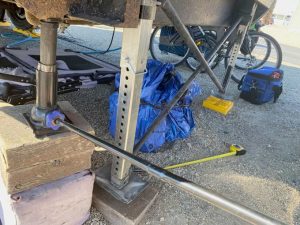
I must thank this former mechanic for his quick thinking. After trying desperately to find a level spot on their property to put our trailer, we realized the spot I had chosen was a bit too steep. It would have been OK if I parked facing uphill, but we like to face northwest for best solar positioning. But that’s another post. So what happened? All the bumps and maneuvering must have dislodged a retainer bolt from the shaft between our two front leveling jacks. We didn’t realize this until I was raising the trailer to hitch back up, and noticed only one leg was lifting. The other was planted firmly in the ground. OK, no need to panic, we found the bolt and replaced it in the shaft that keeps both legs moving in unison. So what’s this about quick thinking? Neal immediately asked if I had a tape measure. Since one leg had already raised, we needed to return it to the same length as the other before securing the shaft. I probably would have discovered this only after retracting the legs all the way. Well, at least one of them. By measuring the planted leg, and extending the other until it matched, we were able to replace the bolt just once. Thanks again Neal. Once a mechanic always a mechanic, I guess.
Jun
02
2009
Road Trip USA Takes You to the Real AmericaPosted by Rene in Attractions, Dream, Full-Timing Tips, Live, tags: book reviews, Full-Timing Tips, Good Eats, road trip, RV, RV road trip, spending, Tourist Traps
Even after two years of living on the road, Jamie Jensen’s book Road Trip USA: Cross Country Adventures on America’s Two Lane Highways has been helping us uncover countless hidden gems along the way. With our limited bookshelf space in the rig, this is one book that we’ll never let go of. See What’s Really Out There
The best part of Jamie’s books are their emphasis on finding the quirkier, offbeat attractions and towns across America. While there’s enough useful information about major cities and attractions to give you a head start on your research, Road Trip Nation will help you plan more unusual itineraries. Plan Your Next Offbeat Adventure
Music lovers will enjoy discovering blues festivals in the south, and cowboy gatherings in the West. Teetotalling travelers can find their way from the wineries of Westfield, NY to Napa, CA, to the world’s biggest six pack in Lacrosse, WI. They’ll also learn to steer clear of Shamrock Texas on St. Patrick’s Day, even though they could kiss an actual piece of the Blarney Stone in that town’s Elmore Park. Why stay away? Because Shamrock is a dry town. Road Trip USA It’s also a useful tool that teaches you how to properly pronounce town names before you arrive and look like a tourist. Learn how Sequim, WA is really annunciated (“Skwim”), or Cairo, IL (Ki-Ro).
Try Jamie’s Handy Pocket Guides for Short Trips Road Trip USA’s Pacific Coast Highway Guide As West Coast natives, we’ve frequented a lot of his selections in the Pacific Coast Highway Guide We wish we had these books when we lived on the West Coast, as Jamie reveals stuff about places we’ve been to but were oblivious to some local finds, like the Olympic Game Farm in Washington. We thought it was a repulsive canned hunt farm, but it turns out to be a home to retired Hollywood animal actors!
So turn off that satellite radio, drive off the interstates and onto the blue highways, and go find the real spirit of America, because believe it or not, it is alive and well. You just have to look harder these days to find it. But first, pick up your copy of Road Trip USA today. Stay tuned for a guest post from Jamie, about ways you can save money on the road while traveling . . .
May
07
2009
We’ve EscapedPosted by Rene in Full-Timing Tips, Live, tags: Full-Timing Tips, lifestyle, RV Clubs, RV lifestyle, spending, texas
We hinted around that we were thinking of traveling for a while, and Bob wholeheartedly encouraged us to “do it now while you’re young!” He was also the person first to tell us about Escapees, the RVing club for everyone, but especially geared toward meeting the needs of fulltimers. “They’re the best people you’ll ever meet!” he said. After two years on the road, we finally took Bob’s advice and joined. Why did we wait so long? Well, when we started, we just didn’t know if this road tripping lifestyle was going to be a long-term thing. Once we knew we would be fulltimers for the forseeable future, we decided that it was time to relieve Jim’s sister of her generous help in handling our mail and banking issues. And we also wanted to get the hell out of California before we had to pay our vehicle registration and insurance policy extortion bills due in May. So we bit the bullet, and joined up. Why Join Escapees? See, when you don’t rent or own a stick house anywhere, or have a place where you get mail, you literally don’t exist in the eyes of credit agencies, insurance companies, and so on. You can’t even register to vote!
We went to the Escapees headquarters a few weeks ago. The people there were truly some of the nicest RVers we’ve ever met, and were so helpful in getting everything set up for us. We got a new mailing address, and registered our vehicles in Texas. We recently just got our driver’s licenses too, so now, we are official Texans.
So today, we know we’re not really Texans, but we also don’t feel like Californians anymore either. Great. Now when people ask “where are you from?” they’re going to get an even longer story than before!
Apr
18
2009
The One Thing We Can’t Live WithoutPosted by Rene in Full-Timing Tips, Live, Simple Living, tags: cooking, Full-Timing Tips, fulltiming, lifestyle, RV lifestyle
Our cast iron skillets. Back in our stick house, we had a whole collection of Griswold and Lodge Cast Iron Cookwear Cast iron is so versatile, and not very expensive. You can use these pans for stovetop cooking, baking, broiling and even over a campfire. And because you don’t need a lot of water to clean them up, they’re great for boondocking. Our Calphalon pan isn’t nearly that versatile. Best. Cookwear. Ever.
Mar
14
2009
Maintained batteries require maintenance.Posted by Jim in Boondocking, Full-Timing Tips, Live, Spending Money, tags: batteries, Boondocking, fulltiming, Slab City, solar, spending, upgrade
My brother in law Rich O’Connell is a brilliant electrical engineer. He has grown a successful solar business with my sister, built his own off-grid home, designed multi-gigawatt systems, and patented a solar panel washing system. He also designed the RV power system we rely on for boondocking. Recently, I got to meet another expert; Solar Mike. He operates The Sun Works from his solar powered rigs on the slabs. Mike knows the DC side of the business and how to get the absolute most out of what you got.
It just didn’t seem like we were getting the run time out of our batteries that we expected. Loving to boondock as much as we do, we explained our issue to Mike and asked him for an estimate for upgrading the system. He immediately discovered one of our batteries was weak, and pointed out how dry it was. Bone dry.
I might have kicked my feet and mumbled a bit, but – don’t tell Rene – I still think it was worth the $95 we spent on two new batteries to have not been pulling them out and checking them every month for the past year. Truth is, we just forgot.
Had we spent the $4000+ on the original system design Rich gave us, we might have never even had this discussion. But having worked this over with Mike, I now know where in our 24′ trailer we can fit six maintenance free 6 volt batteries – much better suited for our use than the two 12 volts we have. And having done it a couple times now, I know it’s not such a big deal to pull our batteries and check on them. We even carry some distilled water now so we have it when needed.
When we will make that investment is the $3000 question. But that all depends on where we’re going to be purchasing property come Spring, and whether we will need to upgrade what we have or build a larger off-grid system in a shed or trailer. And we’re not even sure where we’ll be next month.
Mar
02
2009
Some things ya just gotta live with.Posted by Jim in Full-Timing Tips, RV Tech, Rants & Raves, Spending Money, tags: Dodge Ram 2500, expenses, maintenance, RV lifestyle
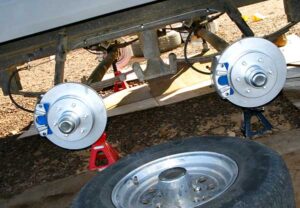
We’ve written plenty about our brakes so I won’t delve any further into the ugly details. But that “nuisance noise” we were told we had by one shop – not the one that ripped us off – came back pretty quick a while ago and never went away.
This time it took almost a couple weeks before the persistent chirp returned every time we applied the brakes. After researching Chrysler brake issues, and noticing the same squeak coming from various other Dodge trucks at many an intersection, we’ve decided we can live with this. Or as this AA1Car report on Silencing Disc Brake Squeal says …
Well, with brand new brakes and a squeak that can’t be eliminated, our choice is simple – we are going to live with it. Or I’ll try to fix it myself the again next time we get fed up. Now if only I could learn how to do my own front end work, or learn to live with how our truck drifts when hands are released from the wheel …
But I don’t a computer to know when my truck won’t cruise in a straight line. Which it still wouldn’t do, after they charged us for the alignment it didn’t need. So they rotated the tires. And it still drifted, though not nearly as bad. Here we go again.
Feb
08
2009
Queen of the Road: Drink It InPosted by Rene in Best of, Dream, Full-Timing Tips, Live, Local Flavor, Quality of Life, Simple Living, tags: book review, Doreen Orion, fulltiming, lifestyle, Queen of the Road, road trip, RV, RV lifestyle, RV road trip, sabbatical, travel
The True Tale of 47 States, 22,000 Miles, 200 Shoes, 2 Cats, 1 Poodle, a Husband, and a Bus with a Will of Its Own by Doreen Orion There are two kinds of fulltime RVer couples on the road. There are couples where both partners really love the lifestyle, and can’t think of living any other way. Then, there are couples where one partner loves it, and the other was dragged on the bus kicking and screaming. Some couples’ personalities fit perfectly into fulltime RVing, while others try it, then put their RV on the market before summer’s end. If you happen to be the reluctant RVer, Doreen Orion’s book – Queen of the Road – is perfect for you. |


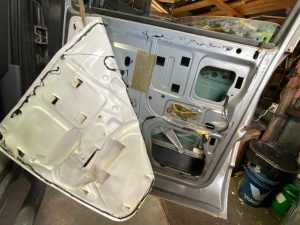
When we were visiting the Davenports before the holidays, Randy convinced me that if you want something done right you really do have to do it yourself. He has a garage fully equipped with tools, and knows how to use them. So we tore apart our brand new brake system and applied brake silencer spray to the back of all the pads. Something the last Dodge shop we went to – the one that did rip us off – did not do when they installed them.


Entries (RSS)