When we first hit the road one of the must-have items we kept hearing about was a decent pair of walkie talkies. We were told these were vital for communicating to avoid mishaps while backing up the trailer. I’m glad we opted for a decent set of radios, but not so I can hear the navigator telling me to turn right when the trailer needs to point left. She shouts plenty loud enough.
Ever since that Wisconsin tornado warning, Rene cannot stand the sound of that voice on the NOAA weather band. But many a time it has saved us getting into a sticky situation. And since we spend our summers in Colorado, with solar panels on the roof of our rig, it has provided ample warning for us to protect them more than once.
That way they’re always ready to pick up the nearest weather broadcast, and keep us informed of impending doom with that ever so soothing voice.
Very rarely have we ever been in a spot where our trusty Motorola Talkabout radios haven’t picked up the local weather report. And with 22 channels to scan, much fun can be had eavesdropping on others trying not to run into each other in a busy RV park.
Keep Motorola TalkAbout Radios in Your RV Toolbox
Do yourself a favor and pick up a pair of radios to make parking easy and keep an eye ear on the weather. Newer models have a range up to 35 miles! Save on these Talkabouts at Best Buy, or check out the selection of Motorola radios at Amazon.
Putting in a good hard day’s work is good for the body. Put one in with good people, beautiful surroundings and fresh mountain air and it’s good for the soul. Do it on a ranch and you’ll likely get a chance to give your mind a good workout too.
I sit in front of a computer most the year, and have done so in fact for the past 25 years or more. There’s a scary thought.
Don’t be fooled by the plaque atop Gold Hill. At 96 years of age, Vickers Ranch patriarch ol’ Perk is alive and kickin’. His secret? It must have something to do with his outlook on life – that and a daily dose of whiskey. Just ask him how he’s doin’ and he’ll tell you, “Every day is a great day.”
Every day is a great day indeed when working with the Vickers. Ranch work at 10,000′ requires one to be fit for sure. And you can’t beat the beauty of mountaintop views or the calls of the coyotes for a good dose of awareness. Counting bales and troubleshooting a broken stacker or determining proper blade rotation on a multi-head mower tends to put the old noggin’ to work too.
This kind of workamping sure beats staring at a computer screen all day. What do you do to exercise your mind, body and soul?
When it comes to your RV’s cost of ownership, is it what you expected?
Many RVers freely share worksheets showing what it costs to live on the road, but the elephant in the room is the long term costs of maintaining your RV and support vehicle.
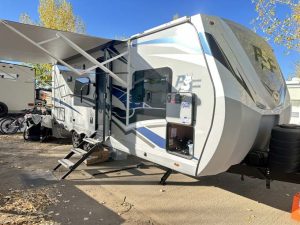
This is my first post dedicated to long-term costs of towing our 2007 24′ Arctic Fox fifth wheel trailer with our 2006 Dodge Ram 2500 diesel 4×4 SLT quad cab.
With that being said, the Dodge pickup isn’t exactly known for a low cost of ownership. Edmunds says our 2006 model should be expected to cost about $56,561 over five years to own (including everything from taxes to repairs), while our dream truck, a 2011 Dodge with a built-in exhaust brake will cost $65,159 over five years.
So, how accurate are their numbers?
According to my records, we’ve spent a grand total of $29,513 on our Dodge since we bought it with about 24,000 miles on the engine in April, 2007. For numerically challenged people like myself, that’s $7,378 a year.
This figure includes everything including fuel, registration, insurance and repairs. Buying used probably helped reduce Edmond’s figure, assuming they include the hefty licensing and registration fees that accompany buying a new vehicle.
That makes me feel good! Especially considering the kind of wear and tear we put on the truck by hauling the house around. As our odometer hits 100,000 miles in the next season and our Cummins engine warranty expires, let’s hope we can keep this low cost of ownership up!
Since we purchased it in 2007, we’ve spent $8,662 on everything from trailer brake repairs to solar upgrades to general maintenance.
That’s $2,156 a year.
RVers are left by the wayside when it comes to the real cost of ownership.
There are no sites like Edmunds (that I know of) which show RVers what to expect over the long haul for their make and model.
Maybe this is because RVs come with so many options and variables, some with more duct tape, some with less, some get hauled up, down and around the country, some hardly move at all.
This RV.net article is one of the best I’ve found when it comes to analyzing RV ownership facts and figures over a year, but it still doesn’t consider long-term variables.
One thing RVs all have in common is their rapid depreciation rate, which, like a car, is all the more reason to buy a slightly used model.
I confess that we didn’t buy a used trailer: at the time of our purchase, we weren’t living the debt-free lifestyle, and neither one of us had ever owned any brand new vehicles. We felt that a brand new trailer was our reward for knocking ourselves out over our business for the last decade. Even though debt-free guru Dave Ramsey would think we were morons for buying new, we both still agree that we made a good choice. I’m certain we wouldn’t do it again, however.
Our Choice Still Works for Us
Owning a RV isn’t cheap for anyone, but it’s the overall lifestyle itself that costs less than when you live in a stick house. Some RVs like ours are cheaper to own than others but they all have necessary repairs, which although they shouldn’t be a surprise, are always painful and happen when you least expect them to.
Most of our road ripping friends have gone through at least two different RVs since they started, but we still love our house on wheels.
The main reason for staying with what we have is also about money; getting into anything newer would require financing, which we just won’t do.
Our fifth wheel – truck combo has worked well for us and and while I would love to feel like a rock star in a Prevost or a Foretravel, I know I wouldn’t love the cost of paying for a single tire on one of those beasts, unless I could pay for every single related item in cash.
That ain’t gonna happen today, but hey, that’s the goal!
After four years on the road and nearly 70,000 miles logged on the Dodge, there are a few places that have remained near and dear to us, the kind of place we want to go back to again and again. Vickers Ranch is one of them.
And now that the ranch cabins are for sale, there’s a lot more people who are going to discover the magic of this 100-year old Lake City legacy.
Recently I talked to Larry and Paul Vickers about the family’s exciting new Vickers Horse River Ranch Property that gives the public a chance to own one of their hand-crafted, historic log cabins.
In this 15-minute intervew we talk with Larry and Paul Vickers, whose family helped establish Lake City during the peak mining years of the late 1800s.
Jim and I worked at their ranch during 2008 when we thought we wanted to buy a small resort.
Then we realized: What, are we nuts?!
Now that we know the realities of the resort life, we can say we’re definitely not cut out for this kind of gig. The work was the hardest we have ever done but the family’s kindness and generosity made it all worthwhile.
Our adventures at the ranch were chronicled in blogs post such as:
We’ll hopefully be heading back to the ranch in a few weeks to get our share of hay buckin’, cowboy coffee and manual labor, so stay tuned for more Vickers Ranch workamping adventures.
Meanwhile, if you or someone you know would like to be a guest on our Blog Talk Radio show, drop us a line!
Sixteen years ago, a co-worker kept insisting, “You gotta meet my roommate.” Later that week, on the 18th of May, he set us up at the Gold Cane. It turns out Spoonie just wanted your room.
Exactly two years later (almost) on the 17th, we were married. It was the happiest day of my life. Really.
Every day together is a reminder of just how happy. Thank you. For everything. Really.
Here’s that informative post I promised before i got distracted by those great steaks and cocktails at the AA. I hope at least, that anyone who publishes an RV blog – or any website for that matter – will find this information, well… informative!
A while back, fellow Nü RVers those tech nomads informed us that a certain website was repurposing blog posts, not only from this site, but theirs and those of a number of other RVers.
Sure enough, a simple search revealed that entire posts of ours, including photos, were being republished in their entirely without our permission. Furthermore, we discovered that the site in question was a paid membership site, so it was using our content for profit!
The infringing website’s owner argued that because we make our posts available via rss feed, that the content was free to use as he wished. A bogus claim from someone who hadn’t done his homework, but a slightly grey area nonetheless.
TIP: To search a specific website for something you wrote, use Google and enter a distinct phrase followed by “site:” and the domain, like this…
Replace domain.com and the phrase or keywords to meet your needs.
While we were able to remove all existing and future content of ours from the website in question with one request, it got me thinking. I decided to do my own homework regarding the rights of web publishers, and gladly share what I found out here.
Ownership Rights of Web Content Publishers
According to the The Berne Copyright Convention, everything on the internet is considered copyrighted the moment it is written. Under the Berne Convention, copyright is automatic upon publication and does not require formal registration. When the United States joined the Convention in 1988, however, statutory damages and attorney’s fees continued to be available available only for registered works.
According to the World Intellectual Property Organization Copyright Treaty of 1996, “compilations of data or other material (databases), in any form, which by reason of the selection or arrangement of their contents constitute intellectual creations.” All blog content is stored in a database and is therefore an intellectual creation.
The Digital Millennium Copyright Act of 1998 (title 17, U. S. Code) states that “Copyright protection subsists, in accordance with this title, in original works of authorship fixed in any tangible medium of expression, now known or later developed, from which they can be perceived, reproduced, or otherwise communicated, either directly or with the aid of a machine or device.”
Finally, by republishing our copyrighted content on a for-profit website I confirmed that the infringing site was in violation of the federal copyright fair use doctrine, as described in sections 107 through 118 of the copyright law (title 17, U. S. Code)
Please note that I am by no means a lawyer, not even close, in any way. So I consulted one. I visited the free legal advice website LawGuru.com and asked:
What law can be cited when notifying someone who has republished original website content without permission, when they insist syndicated content (rss) is in the public domain?
My research proved me correct. Here is the answer I received:
You can cite 17 USC 106 which defines your exclusive rights, including a right of attribution, and 17 USC 501-506 which define your remedies. 505 authorizes recovery of attorneys fees and expenses and 506 may make it a criminal offense, particularly when done via the web.
However, you need to know that for the Court to have jurisdiction to enforce a copyright in the US, you must first apply to register it. It is a simple process for a copyright attorney to do that online. You should use an attorney, so that the attorney can simultaneously write a CDL (cease and desist letter) to this apparent infringer. A letter from you is not likely to have the same effect and not likely to be worded for optimum impact. In fact, most do-it-yourself non-lawyer CDLs are a disaster and some even create grounds for countersuit.
There are numerous blog aggregators on the interwebs that legally republish copyrighted content. They do this by only publishing an excerpt, assigning attribution, and including a link to the original source. But there may be times when one might wish to republish content from another source in its entirety, when it is appropriate to do so. Like when said person owns the copyright to the original content, or has explicit written permission to do so.
I’ve been considering doing just that with a new Tripawds Blog that will republish posts from our five featured blogs, giving readers one location to find all the best news, gear, gifts and nutrition advice for three legged dogs in one convenient site. Just how would I go about doing this?
To republish our own content and consolidate posts from multiple different blogs in one site, I plan to use the Autoblog plugin from WPMU Dev. Should you choose to do the same, of course, we know you’ll be certain you have the rights to do so.
How do you write a tribute for someone whose spirit simply cannot be characterized with words alone?
Bob did a good job at describing how Chris Crawford was awesome in his Talking Tech blog. And the Eureka Times Standard published a rather eloquent obituary for Chris, who would have easily discerned they didn’t write it.
To know Chris Crawford was to love him. Personally, I feel that after high school and college, one rarely gets the opportunity to make a new lifelong friend. Chris made it simple. He and Elaine welcomed us into their home, and their hearts.
After knowing Chris just a short time, we became very close friends. After the various parties he hosted, or times he and Elaine would treat us to dinner or cocktails, I would thank him sincerely. His reply was always the same: “We’ll have the rest of our lives to make up for it Jim.” My only regret is that I won’t be able to keep my end of that bargain.
Chris was always our biggest advocate. He believed in us when others thought we were crazy. In dealing with the City when attempting to convert an abandoned property into live/work space, he solicited letters on our behalf.
At a public debate when running for Supervisor where his opponent answered my question about what might be done to assist local small internet-based businesses with “government can’t help you…” he easily illustrated aspects of his seven point plan that could.
And, when we decided to follow our dream by selling our home and traveling the country with Jerry, he was there at our sendoff and frequently commented on our travels…
“…we fully appreciate your wanderlust. As you note, it’s always heart warming to know there are people who love you, know you for who you are, and pray for your safety while you pursue this adventure.” — Chris Crawford’s comment on this post.
So much has been said about Chris already. So we will sum this up in stereotypical Crawford fashion…
Look, it’s like this. He led a good life. He was a very fortunate man to have found such a wonderful soul mate in Elaine. He was successful in business, and passionate about what he believed was best for the community. Cancer may have broken his body, but his spirit shall live on forever.
Gregg and Jay are right. “Was” is indeed the hardest word. God speed my friend. Thank you for being you.
It was over two years ago now that I first pondered publishing a post titled, “I Could Die A Happy Man.” Now that may sound morbid to most, but I meant it in only the most positive sense, and still do.
My reasoning at the time was that we had enjoyed a wonderful life with Jerry on the road, where he taught us – among many other enlightening lessons – that every day is a great day, no matter what life throws your way. I was recently reminded of this by a comment on some satellite radio show about coping with difficulties. It went something like this…
“You always have a choice. Even if your only choice is how you react to the situation, you still have a choice.”
So true. I choose to be happy. It sounds simple enough, but it can be harder than you might think, especially when life throws you a curveball. Or worse, beans you high and hard.
With the anniversary of Kris’ death coming up, and doctors suddenly telling another dear friend cancer is killing him, I thought it high time to share how I do it. Be happy that is. Consider it a bit of open source enlightenment.
Ever since we hit the road with our three legged dog after his cancer diagnosis and amputation, I have been privately working on this personal mantra…
“I am available to more good than I have ever experienced, imagined or known ever before in my entire life. So I open myself to all the wonderful gifts the universe has to shower upon me. And I am grateful for living a happy healthy life free of pain and discomfort, thriving in tune with the cosmic dance. I know the universe is conspiring on my behalf, so I free myself of guilt and blame and think kind thoughts, speak kind words, and act kind deeds toward myself others and the environment. Should I experience stress or pain, I choose to let it go knowing that I am completely free without it, because I am most happy and comfortable enjoying every moment to the fullest choosing to live life in the ever present now.”
It’s an ever-evolving work in progress but that’s what makes it work so well. I repeat it most often when out for my morning runs. Another friend, Dave Berman, found it enlightening enough to use a variation we agreed upon when he launched his Manifest Positivity blog. You can ask Dave how the differences he suggested I incorporate make the mantra more effective, he’s the certified NLP practitioner.
But I am a creature of habit, and I believe this is working for me. Call it mumbo jumbo if you will, but a little good juju can go along way if you ask me. So I recommend anyone seeking a little more happiness from life develop a mantra of their own. Below are a few resources that led to me developing mine.
The Secret – The law of attraction is no secret after all, and anyone who has read or seen this will recognize the first few words of my mantra.
Pronoia by Rob Brezsny – Never read it, but a few of the things I tell myself I learned from Dave, who swears by its teachings about how how the whole world is conspiring to shower you with blessings.
Am I Being Kind by Michael J. Chase – I still owe Dave a public thank you, and book review for this quick read about how asking one simple question can change your life, and your world.
Excuses Begone! by Dr. Wayne W. Dyer – Didn’t read this one either but did take plenty of notes during Dr. Dyer’s seminar of the same name on PBS about how to change lifelong, self-defeating thinking habits.
There’s a lot to be said for staying in one location, if only for a month or so.
After just a couple of weeks at our current gig, caretaking a vacant property in Southern Arizona, we’ve already settled in nicely and created daily routines that revolve around working, playing, eating and resting.
These routines are much like those of a stick-house dweller’s, except that we don’t see anyone else all week until we leave the property to go grocery shopping.
It’s just us and the wind most days. Oh, and the nasty javalenas.
Caretaking 101
The assignment is easy and our bosses are great people. They’re not asking much from us, so we have plenty of time to catch up on our own work and bringing home the bacon. We love it.
They’ve known the property owners here for a while and were caretaking a neighboring property, but just left.
The weather’s almost been nice enough to work and eat al fresco, but it just turned ugly and we hope this is only temporary.
Still, even during the brisk 50 degree evenings we’re seeing incredible sunsets, like this one. I’ve made a pledge to see every one while we’re here. Most of them look something like this (and no, I didn’t Photoshop this image).
Meanwhile, our Wyatt loves the freedom to roam the fenced property like a dirty ol’ ranch dawg. He’s made a new friend too.
That nasty javalena drives Wyatt insane (moreso than usual) whenever he makes an appearance at sunset. Gregory provides hours of entertainment for all of us.
Water, Water….everywhere?
I was surprised to see that even the smallest properties around here have irrigation running out to landscaping, chicken coops, you name it.
After all, we come from Colorado, where it’s illegal to wash our truck, or water our outdoor plants with our own well water. Water is so precious to Coloradoans, because no water comes into the state, but it all leaves and heads south . . . eventually ending up right here, in the big ol’ Rio Grande dustbowl along the border.
Once that precious resource gets here, people get to water their plants with the very same water that I’m not allowed to use in my backyard, where it originally comes from.
I have to buy water from our property association if I want to use it for outdoor purposes. But Arizonans don’t. Huh?
I like griping about it. Jim says I’m just mad because I can’t use water like this on our property without getting busted. You bet I would, if I could get away with it.
Off the Grid, Away from the Rules
But here in Southern Arizona, just shy of the border, it’s no-man’s land. People who live here are free to do what they want. From the funky handbuilt houses to the backyard shooting ranges, in a lot of ways the Wild West lives on.
And why not?
If you’re rugged enough to make a home for yourself here, I guess you deserve to make your own rules. It’s not exactly the most hospitable environment and most people aren’t cut out for it. I know I’m not.
Someone’s gotta do it though, right?
There are some great sights nearby, like the artsy old mining town of Bisbee, which we plan on exploring more during our stay.
Until then, we’re putting our noses to the grindstone, working away to make a buck on that great hamster wheel of life. We put in some long hours most days, but at least we’ve got a spectacular view out of our office window.
Hi all, I am hoping to be on the road by April. I am wondering what you “old timers” would do differently if you were just starting out?
While we don’t like to “should” all over ourselves, through the four years we’ve been on the road we’ve learned that there are some things we might have done differently when starting out.
We hardly spend time or money at RV parks, but this club has saved our necks and our wallets several times. Nearly all camping membership clubs suck, but not Passport.
There are tons of participating RV parks, most without tight restrictions, and they cost half of what they normally would, some as little as $7 a night for full hookups!
Our first year out we spent far too much money paying full price for RV park stays. Now, I wouldn’t travel even halftime without a PA membership.
It took us two years to figure out that the services you get from Escapees can’t be beat. Our first year out we had a family member do our mail for us (they volunteered). But it was a hassle for them, and we felt the weight of obligation after we knew this sabbatical was turning into a lifestyle.
We also would have saved a ton on our residency / vehicle fees had we turned Texan sooner.
3. Invest in a bigger solar system.
We started out knowing we would boondock, but we didn’t realize the extent of it, nor how much it could save us. Our system was adequate for a long-term vacation but not for making a living with.
We’ve slowly upgraded, but when we had the money four years ago we should’ve started out with a bigger system.
Boondocking gets us closer to our “real” camping roots as backpackers, by allowing us to get as far away from civilization as possible, without having to dig a craphole.
4. Travel without debt.
When we started out, we had not paid off our rig, even though we had the money in savings. I hated knowing that we had real bills to pay and no real income, but I didn’t want to see that pile go away.
For the first time in our lives, we truly felt the meaning of “freedom.” Living a with debt, much less fulltiming with a sporadic income and debt, is a big drag on happiness…at least to us it is.
That’s about all of the “should haves” we can think of. Remember, researching your road tripping lifestyle is key to long term success, and planning how you’ll be comfortable is critical. Don’t hit the road without doing either.