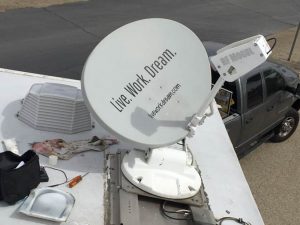
During our stay at Landa Park in New Braunfels earlier this year, I thought we discovered the headquarters of HughesNet, our mobile satellite internet service provider. But it was just some company with the same name that I have decided to call the team at Hughes: FAPCo
FAP (Fair Access Policy) n: A download threshold assigned by Hughes to each HughesNet service plan that limits the amount of data that may be downloaded during a typical day. A small percentage of subscribers who exceed this limit will experience a temporary reduction of speed.
Ha! Temporary? Reduction? Like I said, Ha! You definitely know when you’ve been FAP’d, because your connection will crawl to a virtual halt. Without warning. And it can stay that way for up to 24 hours.
Our service plan comes with a daily download threshold of 375 MB. Every once in a while, if we don’t pay attention to how much time we spend online – or what we download – in a given day, we may get FAP’d. But during our stay at Landa it happened a number of times. Enough to think someone was piggybacking our network. But we’ve learned to lock it down tight, and one look around made us really question if any of our neighbors were capable of hacking us. So we sought a better method for monitoring our daily HughesNet account usage. Here’s what we discovered …
Our fellow full-time geek friend Sean, of Our Odyssey told us about the HughesNet FAP Monitor. This Windows-only utility displays an icon indicating your current HughesNet usage status and warns of any imminent Fair Access Policy violation. We’re no dummies, but had a terrible time getting this to work on Rene’s machine, but with Sean’s perseverance we got it configured and working. For a while. One day it just stopped working. And we gave up trying to fix it after discovering various discussions about HNFP not working.
The one thing the HughesNet FAP Monitor was good at, while it worked, was making René obsessed about our current FAP status. So I quit trying to make it work after finding a better solution. One that works on my Mac (or any machine) and isn’t always flashing in my face.
This method lets me check our threshold status, when I want to. The script adds a “Remaining (MB)” column to our HughesNet usage page with convenient color-coding to indicate when we should step away from the computers for a while. It was simple to set up, here’s how …
This isn’t to say we’ll never get FAP’d again, but at least we can easily monitor our usage now without getting all obsessive about it.
Since drafting this post we have discovered an even better way to avoid the FAP. We have gone redundant, and now also have a Verizon Wireless MiFi 2200 Intelligent Mobile Hotspot. This allows us to spread our bandwidth usage over two different accounts. It also gives us two methods to connect, in case there is something blocking our satellite, or we have n cell phone coverage. More about this later…
Now that we’re getting a new iPod, maybe I can convince René we need an iPhone! Just check out this amazing new iPhone app that lets you easily find any satellite…
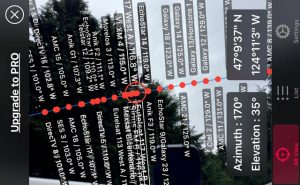
This next generation satellite finder is straight out of Star Trek! What will they think of next? Simply point your iPhone anywhere towards the sky and all the satellites will appear on the live video screen. Kinda surreal and freaky, if you ask me.
The best part? Again, if you ask me … Now you can easily tell which trees will block which satellite. That’s a good enough reason for me to buy a new iPhone! Sure, like that’s gonna happen.
This new DishPointer Augmented Reality application uses the accelerometer and the compass of the new iPhone 3GS. The compass apparently has a bit of a lag, so when spinning the phone right or left the satellite belt is shifted with a slight delay but up and down works in real time.
Of course, I would have first hand experience with this if I had an iPhone. I only know because Alan let us know about this and other cool satellite iPhone apps he’s been working on over at dishpointer.com. My first post about his DishPointer satellite alignment widget has been one of our most popular posts here, so I just had to share this new cool tool!
Here’s another one of those “luxury” purchase decisions that make one contemplate that old want vs. need dilemma.
In reality, we want a new iPod because the refurbished one we bought over two years ago no longer works. But we believe we need one because traveling cross country can drive one batty when forced to consistently fuss with the radio dial only to find the same static, classic rock, and religion. And two batty people can only take being trapped in a truck for hours a day with Eddie Money and Styx for so long.
And the former is easily answered not only because I am a Mac Addict, but I did my homework. I had no idea iPods even came with such great capacity now, so we need not be selective now about which music we add. And I am still upset over the short lifespan of our refurb – the one we originally had to return for another unit. The same one in which I replaced the battery without improving it’s playtime. But there I go digressing again. I also I discovered certain lesser capacity third-party MP3 players cost even more than the Apple iPod. That, and because we don’t need an iTouch.
You know all those appliance manuals that came with you RV? Dig them out from under the bed and read them, at least once a year. It will remind you of certain things you need to maintain to keep your rig in prime operating condition.
Take for instance the water heater. It has an easily accessible anode rod that should be replaced at least annually. All RV water heaters are protected by this magnesium or aluminum anode to prolong the life of the tank by absorbing the corrosive action of hot water. Basically, it will corrode before the tank does. And if it corrodes entirely, it can no longer do its job.
This is just one of those little things we forgot all about. And we are not alone. But it is also one of the most simple items on the honey-do list of any RVer. Just make sure the hot water has been turned off for a while or you may get scalded, and that your hose is disconnected so the system is not pressurized.
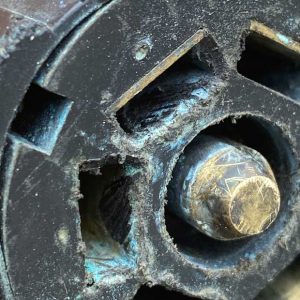
Then release any pressure in the water heater tank by pulling its relief valve. Now get yourself a deep socket – the rod in our Suburban water heater has 1 1/16″ head – and loosen the threaded anode rod at the bottom of the water heater. (Yes, from outside your rig.) Let all the water drain and flush out any debris with a hose. this took me a while because we had accumulated quite a bit of debris as you can see by how our old anode looked.
Replacement anode rods can be found at any RV parts counter or service center. To prevent leakage, apply teflon tape to the threads before screwing in the new anode. Make sure it is screwed in straight and secure, fill the tank, run a faucet to allow any trapped air to escape, turn on the heater, and you’re set for another few months. Or at least until you remember you forgot all about the water heater anode again.
Nearly two years of keeping up this RV travel blog and it dawns on me that we’ve really only written this one boondocking tip, for conserving water.
Well, considering we have now gone as many as 45 days without hookups – not too recently, mind you – it seems appropriate to provide some tips for making the most of your boondocking days.
First, we refer to boondocking here as anytime we’re not hooked into the grid for the night. Ergo, any night spent without hookups is boondocking to us – whether it be out in the boonies or in a WalMart parking lot. Technically though, according to a “Disconnected RVing” article in the Escapees magazine we now get; if your staying in a campground without hookups, that is considered Dry Camping.
But this post isn’t about linguistics. It’s about seeing how long you can go without hookups, comfortably. And comfort is the key here. It takes a certain level of which to truly enjoy long term boondocking. Which we do, so keep that in mind as we share our methods, or madness depending on how you look at it …
Go Solar – A basic system including solar panel, charge controller and inverter will help keep your batteries charged and provide AC power when not plugged in. As with anything of course, the more you spend the more you get. A large bank of 6v batteries and multiple solar panels may enable you to go longer before re-charging, if you have to at all. But this can quickly drain the pocketbook. We get by with one 120w solar panel, a 2400w inverter and the two 12v RV batteries that came with our trailer.
Stay Charged Up – To keep your batteries healthy, never let them drain completely. Many recommend charging batteries if they fall below 12 volts. Our inverter will automatically shut off if voltage drops below 11.7 volts. Get yourself an accurate voltmeter and run your generator to charge batteries as often as necessary.
Maintain those Batteriers – Be sure to check your batteries regularly. We learned the hard way. If they are not the sealed maintenance free type, keep distilled water on hand and top them off as necessary. Boondocking often means bumpy roads, so ensure all battery connections are tight, and no wires may be causing shorts in the system.
Use the Sun – Solar power is best suited for “float” charging which is basically keeping batteries topped off when they are about 90% charged. So take breaks during the day to let the sun do its work. A generator is better suited for “absorbtion” when battery power is further depleted. The best time to fully charge batteries with your generator is in the morning when they are at rest.
Consider Your Position – You know your rig. If you have solar panels, park so they get maximum exposure to the sun throughout the day. For us, it is best to park facing the northwest. That way our satellite dish will not cast a shadow on our solar panel.
Go in the Woods – Use vault toilets whenever available, or a tree if not, to conserve water from flushing.
Bundle up – In cold weather, put on a sweater or grab another blanket before considering wasting battery power and propane by running the furnace.
Strip Down – If it’s hot, put on your shorts or consider moving on to where it’s not. Your air conditioner will quickly drain your batteries, if your solar power system is capable of running it.
Stock Up – Before heading out to the Boonies, always ensure your fresh water tanks are full and you have plenty of gas for your generator and propane in your tanks. It helps to have empty waste water tanks too!
Stock Up Some More – Carry extra fresh water with you when planning extended stays without hookups. We use three collapsible 5 gallon water jugs and various other containers for topping off our tank.
Conserve – Sounds simple, but it is the most important thing to consider when boondocking. And it relates to both power and water. Use headlamps or battery powered lanterns rather than your house lights. Never leave lights on when not needed. We go so far as to remove the LP leak detector fuse so its LED light doesn’t glow.
Conserve More – Never let the water run when doing dishes. Clean pots and utensils using a bowl of soapy water then rinse all at once under dripping water. Using paper plates and disposable cups will eliminate the water needed to wash them. And remember, cast iron pans don’t need scrubbing and can usually just be wiped clean.
Conserve Even More – When taking a shower, run the water into a tea kettle or other container while it heats up so none is wasted. Take short bird baths with as little water as possible, or consider skipping daily showers. Use body wipes to stay feeling fresh.
Play The Shower Game – Try to see how little water you can actually use. Wet down within a few seconds. Soap up, then rinse off quickly. Shower immediately after one another so you don’t have to wait for the water from the faucet to warm up again.
Fill Your Black Tank – Grey water tanks often fill up quicker than your black water. So wash dishes using a tub and pour the dishwater down the toilet. Turn the water pump off when doing this so the toilet will not flush.
Make One Pot Meals – Plan meals you can make using one pan to reduce dish washing. We find that grilling uses the least amount of dishes and is much more enjoyable anyway.
Wipe Before Cleaning – Wipe out all dirty pans and dishes with a paper towel before washing to reduce the amount of water required.
Work Offline – Our biggest electrical draw is our network. With two laptops, a wireless router, MotoSat dish controller, HughesNet modem and network storage, we can drain our batteries within a few hours on a busy cloudy day. So, we do whatever work we can offline before booting up the network. Leaving the network drive unplugged helps, and once we are locked onto our satellite we also turn off the dish controller since there is no need for that again until we have to put the dish down.
Enjoy it – Boondocking is meant to be fun. It’s the best way to get out and away from it all. When your tanks are empty and full, and you need to recharge yourself, head for hookups to give the rig a good cleaning and enjoy the luxury of lights at night. Then dump and fill up so you can go do it again!
If you have any helpful off-grid RVing, “dry-camping” or boondocking tips of your own please share them by leaving a comment. And let us know how long you have gone without hookups or if you just abhor the idea.
What’s going on here? Neal is saving Jim from having a panic attack.
I must thank this former mechanic for his quick thinking. After trying desperately to find a level spot on their property to put our trailer, we realized the spot I had chosen was a bit too steep. It would have been OK if I parked facing uphill, but we like to face northwest for best solar positioning. But that’s another post.
So what happened? All the bumps and maneuvering must have dislodged a retainer bolt from the shaft between our two front leveling jacks. We didn’t realize this until I was raising the trailer to hitch back up, and noticed only one leg was lifting. The other was planted firmly in the ground. OK, no need to panic, we found the bolt and replaced it in the shaft that keeps both legs moving in unison.
So what’s this about quick thinking? Neal immediately asked if I had a tape measure. Since one leg had already raised, we needed to return it to the same length as the other before securing the shaft. I probably would have discovered this only after retracting the legs all the way. Well, at least one of them.
By measuring the planted leg, and extending the other until it matched, we were able to replace the bolt just once. Thanks again Neal. Once a mechanic always a mechanic, I guess.
Our photos of the cool rig Johan and Dianne de Koe call home started an interesting discussion about this DAF Expedition Vehicle. A few people chipped in saying they spotted the nice couple, and one even researched their specs.
You can do that from the Dutch license plate which, it turns out, may cause trouble back home. If they ever return.
Johan and Dianne have been on the road – primarily off roads – for years. The box they live in has everything you might need. And with a kitchen, bathroom, solar power and plenty of water, they can go anywhere they want, except perhaps downtown.
We met the couple and got the grand tour while boondocking at Lake Amistad, where we sent them off with our maps of Big Bend. They shared with us stories of worldwide travel in their DAF, and how they picked it up for a “bargain” – brand new, after it sat in Dutch military storage for ten years without ever seeing any action.
We’re always on the lookout for cool rigs and campers, so we couln’t resist this photo opportunity at Amistad. Once that is, we realized Johan was not actually the military official we presumed he was before we saw their plates.
I know I’ve said before that it is important for full-time RVers to look into rig issues immediately. But one can only look into certain things so many times, before you just have to give up and live with it.
We’ve written plenty about our brakes so I won’t delve any further into the ugly details. But that “nuisance noise” we were told we had by one shop – not the one that ripped us off – came back pretty quick a while ago and never went away.
When we were visiting the Davenports before the holidays, Randy convinced me that if you want something done right you really do have to do it yourself. He has a garage fully equipped with tools, and knows how to use them. So we tore apart our brand new brake system and applied brake silencer spray to the back of all the pads. Something the last Dodge shop we went to – the one that did rip us off – did not do when they installed them.
Upon completion, I was confident we had conquered the brake squeal once and for all. And I was happy it didn’t cost a dime.
This time it took almost a couple weeks before the persistent chirp returned every time we applied the brakes.
After researching Chrysler brake issues, and noticing the same squeak coming from various other Dodge trucks at many an intersection, we’ve decided we can live with this.
“If an inspection of the brake system reveals no serious faults such as worn, loose or damaged parts, you have a choice to make. You can live with the noise, or you can pay to eliminate the noise.”
Well, with brand new brakes and a squeak that can’t be eliminated, our choice is simple – we are going to live with it. Or I’ll try to fix it myself the again next time we get fed up. Now if only I could learn how to do my own front end work, or learn to live with how our truck drifts when hands are released from the wheel …
We took our Dodge Ram 2500 to a Big-O shop for an alignment after noticing this new issue. After waiting for a couple hours and seeing them test drive the truck a couple times, they told us it didn’t need an alignment. According to the computer, it was fine.
But I don’t a computer to know when my truck won’t cruise in a straight line. Which it still wouldn’t do, after they charged us for the alignment it didn’t need. So they rotated the tires. And it still drifted, though not nearly as bad. Here we go again.
When we left California in June 2007, the cost of biodiesel was comparable to diesel fuel. Maybe a few cents a gallon more, but to me it was worth it to do my part in helping the planet.
However, since returing to the West Coast, we’ve had a harder time finding anything better than B5. Even back in Eureka where we first started filling our tank with it, locating an outlet was challenging.
Suddenly, not as many stations seem to be offering it anymore.
When we finally did pull into a station that had some, they were selling it at $4.00/gallon for B100. Almost twice as much as even the priciest diesel in San Francisco. We pulled out of that station faster than we pulled in.
It’s disappointing to see that biodiesel is becoming less of an option today. Someday in the future we’ll build our own stealth fueling station, but until then, it looks like nasty ol’ Number Two will going into our tank.
If you have any secret sources for finding biodiesel on the road, please let us know with a comment below!
Before we left Northern California, we wanted to take another gander at the rural Siskyou County town of Etna, in the beautiful Scott Valley, just west of Yreka.
Etna has always been one of our favorite spots. With the stunning Marble Mountains as a backdrop, this old ranching community is the gateway to some of the most spectacular, rugged scenery in the state. We’ve had many backpacking adventures in those mountains, and were never disappointed (well, except once when cows trampled our campsite, but that’s another story . . . ).
Since we hit the road, Etna has always stayed on my short list of possible places in which to buy land. And now, with a good basis on which to compare it to, we set out to take a closer look.
As we drove from Eureka to Etna, and still hadn’t arrived after reaching the four hour mark, we started thinking, “Wow, this is farther than we remembered.”
It took us a total of six hours to get there, and “there” wasn’t really anywhere. The biggest metropolis, Redding, (population 90k) is two hours away. Getting to paradise was an exhausting, grueling drive. Hmmm, guess I blocked that out.
Nothing had changed since we’d last visited. The old familar landmarks were still there. Bob’s. The ice cream shop. The brewery. But after taking a hard look around, we realized that the place seriously lacked any kind of ethnic or age diversity, and even a real economy. Not even the summer adventurers like us could infuse enough cash into that area to breathe life into it the rest of the year. What I once thought was quaint, now looked like a tired town going down the path of extinction.
After consulting with a local United Country agent (UC is the best resource for rural property sales) , we hit the backroads to check out some land parcels. But to our disappointment, anything we could afford was either so far off the beaten path that four wheel drive was needed year-round, or it was in one of a couple of tidy rural subdivisions with cookie cutter “rustic” homes. Once we measured our criteria against reality, we knew this wasn’t the place for us.
After just two days, we crossed Etna off our list. And because the rest of California isn’t anywhere I’d want to live, we crossed the entire Golden State off our list as well.
Just a few years ago, we could’ve moved to this little piece of paradise in a flash. We were so tired of Eureka. But our world was smaller then, and we were too stupid to know any better.
Funny how 18 months on the road can change your perspective on things.