Posts Tagged “DIY”

As we boondock here in the Anza Borrego desert with our small 35 gallon freshwater tank and some extra jugs of water, washing my long hair seems like such a waste of perfectly good drinking water.

But after four days without shampooing, I couldn’t take the oily, gritty feel of my locks and surrendered to the ‘poo.

Using about a gallon of water to wash and rinse, I couldn’t help but think there has to be a better way to keep my hair clean.

My question to you, long-haired RV boondocking gals, is: when you dry camp, how do you keep your locks looking (and smelling) good?

When I had a cute pixie ‘do like my RVing friend Tracy (in the pic below) washing my hair wasn’t such an ordeal. But now that I’ve reached my goal of big Texas hair, washing hair when boondocking requires serious water usage.

No ‘Poo Alternatives?

Now before you say “What about joining the “no ‘poo’ movement?” I’ll just say it: the thought of not shampooing my hair regularly seriously grosses me out.

I realize that way back, people used to only wash their hair once a year or so, but I’ll bet if you caught a whiff of their mane you’d be hightailing it back to the future for a long hot shower.

While I would never consider ditching my shampoo, I thought I heard something about how dry shampoos work great in-between washings. Thinking that maybe I could use less water this way, I  searched the web for “dry shampoo recipes” and was surprised to see that something as cheap and simple as a dusting of cornstarch is supposed to suck up the grease and make your hair look nice again. Later this week I’ll test this idea.

Have you tried homemade dry shampoo? If so, what did you think?

Boondocking has a few drawbacks like this, but overall it’s our favorite way to camp. We’re loving it here in the Southern California desert as we buckle down on work, listen to the coyotes yip and yowl and soak in the sun. Free RV camping doesn’t get any better than this!


Comments 25 Comments »

Jim Replaces Dodge Ram 2500 4WD Cummins AlternatorRene mentioned in this post a while back – quite a while back, now – that I would eventually write about what happened to our truck, “stranding us” on the mountain.

Well, we didn’t exactly have to resort to cannibalism, which is  a good thing considering Wyatt is already missing one leg, but I digress…

Now that I’ve finally produced the silly little DIY video below describing how to replace the alternator on our Dodge Ram 2500, that time has come. But let’s take a step back, with the hope of actually making this post helpful for someone.

Symptoms of an Alternator Gone Bad

After putting more than 50,000 miles on our 2006 Dodge Ram 2500 pickup truck, we experienced our first major mechanical issue. With a little deductive reasoning, and the right tools, it turned out to be not that major at all.

How to Find Dodge Ram 2500 Cummins Diesel Serpentine Belt Tensioner Pulley LocationWe never once noticed the voltage gauge acting abnormally. Well, at least I didn’t. And we never noticed the truck having a hard time starting. Again, I didn’t. Until of course, the morning we needed to be somewhere and  were heading out in a hurry at the crack of dawn.

The first indicator of our bad alternator was a dead battery, or batteries in our case. Upon turning the key, the engine attempted to turn over and abruptly ground to a halt. Determined to make it to Wyatt’s class, I quickly disconnected one of the batteries from our fifth wheel and was able to jump start the truck.

Second indicator of an alternator gone bad: it got really hot! As we drove off, I realized that extra battery might come in handy. When I returned to the truck with it, I noticed a burning smell – one of those acrid, electrical burning smells. Acknowledging that it was unwise to drive anywhere – let alone more than an hour on Rocky Mountain backroads – we agreed to stay home and figure out what to do about the truck. Rene parked and I popped the hood. She quickly confirmed the distinct smell, and I touched the alternator. My melted fingerprints have since grown back, thank you.

Dodge Ram 2500 Cummins Diesel Serpentine Belt Tensioner Pulley Location

How To Identify the Serpentine Belt Tensioner Pulley

After a quick consult with el Jefe – Rene’s dad and my mechanical guru – we confirmed the alternator was shot. We also confirmed it was a bad idea to drive the hour to town. If the alternator seized up we could have thrown the serpentine belt and risked much greater damage. Raul told me, “you don’t need help, you just need a boost of confidence.” And that’s exactly what he gave me.

How to Identify Dodge Ram 2500 Cummins Diesel Serpentine Belt Tensioner Pulley LocationMy biggest challenge was identifying the Cummins diesel engine serpentine belt tensioner pulley. Once I found that, I knew I could do the job. This pulley allows you to relieve the tension from the belt, allowing you to remove it from the alternator.

With that done, swapping out the alternator is just a matter of pulling a few bolts.

The serpentine belt tensioner pulley (7) is located directly below the alternator pulley (8) on the Cummins Diesel engine in our 2006 Dodge Ram 2500. It has a square hole in the front into which a half inch socket wrench handle will fit. I was looking for something to loosen, but the pulley is spring loaded – simply pulling down on it releases the tension off the belt.

Tips for How To Replace Dodge Ram 2500 Alternator by Yourself

If you have someone help you, replacing the alternator on a 2006 Dodge Ram 2500 with the Cummins diesel engine might even be easier. This job, however, really couldn’t get much easier. Here’s how I did it alone:

  1. Serpentine Belt Tensioner Pulley Tip for Replacing Dodge Ram AlternatorDisconnect both batteries to avoid any risk of electrical shock
  2. Relieve tension from serpentine belt by inserting half inch socket wrench handle into the front of the tensioner pulley and pulling down.
  3. Secure wrench handle to fan shroud using vise grips (zip ties might work for holding the handle in place,or have someone hold it).*
  4. Remove belt from alternator pulley
  5. Remove wires from back of alternator.
  6. Remove the two long mounting bolts that hold the alternator in place.
  7. Replace old alternator with new one and tighten mounting bolts.
  8. Attach wires to alternator.
  9. Place belt back onto alternator pulley
  10. Reapply tension to belt and don’t forget to remove the socket wrench (and vice grips if using them).
  11. Reattach battery cables.

*Another option might be to just slip the belt off one of the bottom accessible pulleys to relieve tension, but i read about people having a hard time re-routing the belt correctly, since no handy diagram – like the one above – is to be found under the hood..

YouTube Preview Image

That’s it! If the batteries are dead, jump start the vehicle and allow the batteries to charge for at least ten minutes. We didn’t need  a jump. The truck fired right up when I was done, which is  surprising considering how things went for us when we needed to leave at the crack of dawn again the following weekend…

Troubleshooting Dead Batteries with New Alternator

Proud of the job I had done, I was determined to ensure I had done it right. After taking a long test drive, I started the truck periodically for a few days. Feeling confident all was well, we let it sit idle for a few more. Imagine our surprise when the truck wouldn’t crank the following weekend.

We rarely see many cars on our dirt road, especially before dawn. But just as I began shaking my head, Rene flagged down some poor fisherman heading to the lake. I say “poor” because Rene insisted they try to push our four tons of truck back out to the road, uphill. As soon as I released the brake, I nearly ran them over.

Even more perplexing than how on earth she thought these guys could budge the truck, was why their running car would not start our engine when I had jumped it off our trailer battery a week before. Rene describes in detail how the Purcells saved us with their F350, but she neglected to mention one important tip. When jump starting a heavy duty truck, use another heavy duty truck, and connect both sets of batteries!

So what happened? After having the shop investigate further, we discovered the batteries had been cooked. I successfully replaced the alternator, but the batteries were clearly already shot. The bad alternator apparently over-charged them, most likely due to a faulty voltage regulator.

On the Road Again

So while I did save us a couple hundred bucks by replacing the alternator myself, we are still out a few more after replacing the batteries. But with two new batteries and a new alternator, we are now ready to hit the road. A good thing considering the snow is starting to fall here on Jerry’s Acres.

Comments 8 Comments »

Jim prepares house for the winterBy the time we left our mountain home in between snowstorms, it felt like an episode of M*A*S*H with us bugging out and heading South before getting hit hard. On a side note, a weather report from Red Feather lakes last week said it was -2 degrees back home.

But we did have time to winterize the place, which based on that report, we are very glad we did.

In addition to a few minor exterior repairs, below are the steps we took to ensure our house survives the severe Colorado winter.

Steps for Winterizing Mountain Home:

  • Close and/or cover all heating vents.
  • Remove all food from premises.
  • Clean out refrigerator.
  • Remove all ice from freezer and shut off water supply to ice maker.
  • Turn heater thermostat off.
  • Turn off fuel supply and/or electricity to furnace.
  • Turn off fuel supply and/or electricity to water heater.
  • Turn off well pump.
  • Drain well water pressure tank.
  • Drain hot water heater.
  • Drain water from and insulate any outdoor hose bibs.
  • Drain water from all interior faucets.
  • Flush toilets to drain tanks and remove excess water in bowls.
  • Plunge out excess water from all waste water traps.
  • Plug dry toilet bowls with rags.
  • Plug all sink and tub drains.
  • Expel water from lines using air pressure, if equipped.
  • Lock all windows and close blinds/curtains.
  • Deploy preferred rodent deterrence.
  • Plug any exterior holes with steel wool to prevent rodent entrance.
  • Set nail mats in front of all windows and doors to deter bears.
  • Unplug any phantom load items, TVs, stereos etc.
  • Provide contact information to neighbors.
  • Pray that all is well when you return.

What is a nail mat you ask? We wondered the same thing when we discovered the picket fence looking things with nails sticking out of them in the garage when we bought the place. (See photo above.) Turns out the previous owner made these bear unwelcome mats to place in front of all the windows and doors, with the screws pointing up. Let’s hope they work!

The previous owner also told us he never winterized the place, but he was often up there on winter weekends. We told this to a couple neighbors, and they both said, “He was lucky!” We’ll be gone a few months. And considering this was the first time we ever had to do anything like this, we’ll see if these steps did the trick. Talk to us next Spring.

Comments 4 Comments »

Our house is on a septic system and has its own well, something entirely new to this city girl.

I’ve been told by a plumber that it’s fine to throw toxic cleaning products down the drain, but I think of all the cute creatures around here (like this bull moose we saw, just down the road), and I shudder at the thought of poisoning their environment.

I’ve always tried to make my own cleaning products using vinegar, lemon juice and water, and only rely on the hard stuff occasionally, when things are really dirty.

But making homemade laundry soap was something I’d never considered until I came across this terrific Suddenly Frugal blog. It seemed hippy dippy, and I wasn’t sure it would work. But it was so cheap to make I thought I’d at least give it a try.

This is all you need to make your own Homemade Laundry Soap:

  • Arm and Hammer Washing Soda
  • 20 Mule Team Borax
  • Bar of Fels-Naptha Soap

It’s not easy to find these standard ingredients. These proven cleaners of yesteryear are being shoved onto the bottom aisles at the grocery store. HelMart doesn’t carry them (figures), but King Soopers here in Colorado (a Kroger store) does carry all three.

The recipe is so simple it’s ridiculous:

  1. Get a large bucket or tote.
  2. Combine 2 cups washing soda and 2 cups Borax.
  3. Grate 1 bar of Fels Naptha Soap
  4. Mix into powder
  5. Measure 1/4 cup per load.

Wear a dust mask when mixing, or be prepared to inhale a lot of powder. Ick.

It took me maybe 10 minutes to do all of this, and one batch lasts about 4 weeks for us (I only do wash once a week). Total cost of purchasing the ingredients was, $10.84, about the same as a box of Tide, and I’m going to get at least 3 months out of the ingredients (I bought 3 bars of soap). Don’t hold me to that though; I’m innumerate.

DIY Laundry Soap really does work! There’s a reason this stuff has been around forever. But if you try it, keep these tips in mind:

  • Let your washer fill up at least halfway with water, to dillute the powder.
  • You won’t see bubbles in the water, but bubbles aren’t what cleans your clothes, detergent does.
  • For stains, try spot cleaning first by rubbing a bar of Fels Naptha on the stain.
  • There are recipes for liquid laundry soap out there, but they look like a pain, and they’re messy to make. I like this recipe the best.

I would love to keep making this laundry soap while we’re on the road this winter, but I’m not sure I’ll have the space in the RV to store the ingredients. Time will tell when I get to packing again in a few weeks. That’ll be fun.

Comments 6 Comments »

You know all those appliance manuals that came with you RV? Dig them out from under the bed and read them, at least once a year. It will remind you of certain things you need to maintain to keep your rig in prime operating condition.

Replace RV Water Heater Anode to Avoid CorrosionTake for instance the water heater. It has an easily accessible anode rod that should be replaced at least annually. All RV water heaters are protected by this magnesium or aluminum anode to prolong the life of the tank by absorbing the corrosive action of hot water. Basically, it will corrode before the tank does. And if it corrodes entirely, it can no longer do its job.

This is just one of those little things we forgot all about. And we are not alone. But it is also one of the most simple items on the honey-do list of any RVer. Just make sure the hot water has been turned off for a while or you may get scalded, and that your hose is disconnected so the system is not pressurized.

Then release any pressure in the water heater tank by pulling its relief valve. Now get yourself a deep socket – the rod in our Suburban water heater has 1 1/16″ head – and loosen the threaded anode rod at the bottom of the water heater. (Yes, from outside your rig.) Let all the water drain and flush out any debris with a hose. this took me a while because we had accumulated quite a bit of debris as you can see by how our old anode looked.

Replacement anode rods can be found at any RV parts counter or service center. To prevent leakage, apply teflon tape to the threads before screwing in the new anode. Make sure it is screwed in straight and secure, fill the tank, run a faucet to allow any trapped air to escape, turn on the heater, and you’re set for another few months. Or at least until you remember you forgot all about the water heater anode again.

Comments 9 Comments »

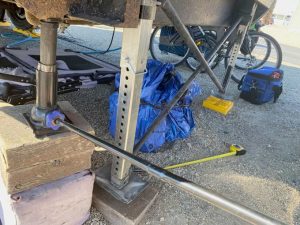
Unexpected Fifth Wheel Trailer Jack ServicingWhat’s going on here? Neal is saving Jim from having a panic attack.

I must thank this former mechanic for his quick thinking. After trying desperately to find a level spot on their property to put our trailer, we realized the spot I had chosen was a bit too steep. It would have been OK if I parked facing uphill, but we like to face northwest for best solar positioning. But that’s another post.

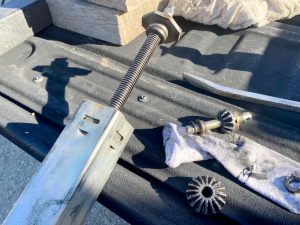
So what happened? All the bumps and maneuvering must have dislodged a retainer bolt from the shaft between our two front leveling jacks. We didn’t realize this until I was raising the trailer to hitch back up, and noticed only one leg was lifting. The other was planted firmly in the ground. OK, no need to panic, we found the bolt and replaced it in the shaft that keeps both legs moving in unison.

So what’s this about quick thinking? Neal immediately asked if I had a tape measure. Since one leg had already raised, we needed to return it to the same length as the other before securing the shaft. I probably would have discovered this only after retracting the legs all the way. Well, at least one of them.

By measuring the planted leg, and extending the other until it matched, we were able to replace the bolt just once. Thanks again Neal. Once a mechanic always a mechanic, I guess.

Comments 7 Comments »

Jim Repacking the Trailer Wheel BearingsThere is one good thing about visiting Los Angeles.

Aside from seeing La Familia, that is. OK two things … Oh, and the food. I guess that makes three things.

Anyway, access to the right tools makes working on your rig easy. And that can help you save a lot of money.

And believe me, El Jefe has all the right tools … and the shop, and the brain, which I picked to learn how to to pack the wheel bearings on our fifth wheel trailer.

Read the rest of this entry »

Comments 12 Comments »

LinkWithin Related Stories Widget for Blogs


Banner