Posts Tagged “Full-Timing Tips”

The Slabs are a hotbed of serendipitous blogger meet-ups lately. Not only are we camped across from The Bayfield Bunch, down the road from HiTek Homeless and across from Tumbleweeds and Lemonade, but this morning we had the unexpected surprise of running into Kimberly, Renee, Darla and the kids from Fulltime Families!

As the enterprising founder behind FtF, Kimberly Travaglino recently published “How to Hit the Road,” a terrific guide to help aspiring families learn everything about the road tripping lifestyle with kids. We can’t recommend it enough!

The Fulltime Families group is a membership-based community of like-minded non-retired parents and kids who’ve made the courageous leap to living life on the road. Fulltime Families is also a terrific resource for dreamers who want to learn all they can about the lifestyle.

Are the Slabs Kid-Friendly?

Kimberly wanted to know the lowdown on the Slabs. Her tribe is camped on the perimeter near Salvation Mountain for the night, and was scouting around to feel around for a kid-friendly vibe. While we wouldn’t exactly call the Slabs kid-friendly, there are a few living here, probably year-round.

But as far as whether or not this place is a good place to bring little humans, our NuRVer friend Sam, who has a grown family of his own, put it best:

“Would I bring kids here and stay a while? Definitely not.”

This wacky, offbeat community with its somewhat seedy-underbelly isn’t the best environment for kids.

“Would I come here for a few days to see it with kids? Definitely!” he said.

Families can skip the local watering holes like the Oasis Club, but taking a trip out to the East Jesus art installations, the mud pots and of course Salvation Mountain, are a one-of-a-kind, eye-opening, unforgettable experience found only here at the Slabs.

Are the Slabs on Your Snowbird Itinerary?

What a hoot to finally meet Kimberly in person after meeting online last year.

We are so impressed with the FtF community she and her husband Chris have built, especially because Jim and I know much time and energy it takes to manage a busy online support group.

So, who else is coming this way in February? If you’re a fellow blogger pointed in this direction, be sure to stop by our encampment and say hello!


Comments 1 Comment »

As we boondock here in the Anza Borrego desert with our small 35 gallon freshwater tank and some extra jugs of water, washing my long hair seems like such a waste of perfectly good drinking water.

But after four days without shampooing, I couldn’t take the oily, gritty feel of my locks and surrendered to the ‘poo.

Using about a gallon of water to wash and rinse, I couldn’t help but think there has to be a better way to keep my hair clean.

My question to you, long-haired RV boondocking gals, is: when you dry camp, how do you keep your locks looking (and smelling) good?

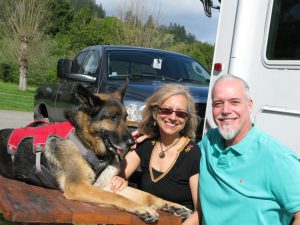
When I had a cute pixie ‘do like my RVing friend Tracy (in the pic below) washing my hair wasn’t such an ordeal. But now that I’ve reached my goal of big Texas hair, washing hair when boondocking requires serious water usage.

No ‘Poo Alternatives?

Now before you say “What about joining the “no ‘poo’ movement?” I’ll just say it: the thought of not shampooing my hair regularly seriously grosses me out.

I realize that way back, people used to only wash their hair once a year or so, but I’ll bet if you caught a whiff of their mane you’d be hightailing it back to the future for a long hot shower.

While I would never consider ditching my shampoo, I thought I heard something about how dry shampoos work great in-between washings. Thinking that maybe I could use less water this way, I  searched the web for “dry shampoo recipes” and was surprised to see that something as cheap and simple as a dusting of cornstarch is supposed to suck up the grease and make your hair look nice again. Later this week I’ll test this idea.

Have you tried homemade dry shampoo? If so, what did you think?

Boondocking has a few drawbacks like this, but overall it’s our favorite way to camp. We’re loving it here in the Southern California desert as we buckle down on work, listen to the coyotes yip and yowl and soak in the sun. Free RV camping doesn’t get any better than this!


Comments 25 Comments »

RVing is one of the cheapest ways to enjoy prime real estate, especially in California where astronomical coastal properties are out of reach of most ordinary people. We found that one way to experience the best of California beach camping without the hefty price tag is through our Passport America camping club membership.

Once again our $44 yearly Passport America membership has paid for itself. Last Tuesday after a sad goodbye to my family in Los Angeles, we headed south to San Diego to see Tripawds friends.

Our destination was Mission Bay RV Resort, which offers 50 percent savings to Passport members during winter. This coastal campground is normally $50 a night for a bare bones back-in RV site, but with our Passport America membership we got our sweet spot for half off!

Many of Passport’s affiliated RV parks are located in smaller towns that want to attract more tourists, but oftentimes you’ll find gems like these in major destinations.

We’re always super frugal about paying for campgrounds, but since joining Passport in 2008, we’ve never once regretted spending the money on this membership. It always seems to come in handy whenever we need full hookups.

If you’re on the road and haven’t joined this club, do it today. I guarantee you a Passport America membership will pay for itself the very first time you use it!


Comments 7 Comments »

If you’re a fulltime RVer or just thinking about it, be sure to visit Work for RVers and Campers, one of the premiere websites for RVers to visit when looking for ideas about how to make a living on the road.

Work for RVers and Campers is for RVers who want to earn money to support a traveling lifestyle. You’ll find free paid employment and volunteer workamper positions along with work-at-home business tips for travelers. Coleen’s newsletter also has inspirational tips and workamping ideas.

We found this resource during our early days of researching the road tripping lifestyle and we continue to pop in whenever we’re looking for new ways to generate income. Now, we’re thrilled to be featured on the Worker’s Profiles page!

Coleen and Bob are a real source of inspiration to us and if you’re thinking about this lifestyle, their story will inspire you too. They’re one of the web’s most well-known experts on making a living from the road. After all, they know a lot; they’ve been fulltiming since 1992! Here’s a little bit about this inspirational couple:

Bob and I spent over a decade living in a recreational vehicle of some kind or another. They included several travel trailers, a pickup camper, a park model trailer, and a motorhome. Along the way, we worked and supported ourselves. We are proof that it is not only possible, but practical, to earn a living while full-time RVing.

Much of what I write is based on our experience. Some of it comes from corresponding with thousands of campers and RVers. I also share what I’ve gleaned from employers and managers who hire and work with work campers and other RV workers.

If you’re dreaming of the fulltime RVing lifestyle or actively looking for work, we can’t recommend Work for RVers and Campers’s Resources enough. Visit today!

Comments No Comments »

Unlike many things in life, Jim and I found that RV road tripping is all that it’s cracked up to be (for us, anyhow). On this Thanksgiving holiday, here are a few RV-related things we are thankful for. Now, if you’re a RVer, what are you thankful for?

RVers are Thankful For:

Adventure. From far-reaching corners of North America, like Big Bend National Park to the coast of Maine, traveling by RV allows us to see so much more of this country than we ever thought possible.

Escapees Days End Directory. One way we can afford to live this lifestyle is by finding free camping spots. Our preferred method: this $10 Days End Directory that you can only get through Escapees. We’ve literally saved hundreds of dollars with this guide.

Experience. Each year our lives become richer because of everything we experience on the road. It’s not always perfect, but even when things have sucked, we learned better ways to handle adversity. When you live in 200 square feet, you’re forced to roll with the punches instead of punching each other out!

Freedom. We live life on our terms, outside of the box and far away from mainstream ideas about how adults are “supposed” to live their lives. We are grateful for the freedom to choose this path.

Free Public Lands. The West is definitely the best when it comes to free camping in America. With so much free camping to choose from, you could spend a lifetime boondocking west of the Mississippi and not camp in the same spot twice.

Friendship. RVers really are some of the nicest, most social people around! We’ve met more people since hitting the road than we ever did by living in one spot, and most of them have been great. It’s so much fun to randomly meet members of your own tribe when you’re traveling.

Internet Connectivity. With the Internet available anywhere you go (especially if you have a Motosat dish), your office view can change every day when you make a living on the road.

Pull-Thru Campsites.  Our little 24′ fifth wheel can fit just about anywhere, but let’s face it, pull-throughs are so much easier to park in, especially after a long day on the road.

Being Debt Free. Everything we enjoy about living on the road wouldn’t be possible without a simple, debt-free RVing lifestyle.

Staying out of debt gives us the fearlessness we need to explore new ways of making a living, like our newest business venture that we’re so crazy about!

Happy Thanksgiving!

Tomorrow as we sit down to dinner in Austin with our RVing friends, we’ll raise a glass to these perks of living the road tripping lifestyle. Now, what will you toast to on Thanksgiving?


Comments 11 Comments »

Until recently, full-time RVing with kids was uncharted territory for all but a handful of courageous families. But now for the first time ever there’s a comprehensive how-to book that can assist you in making this life changing decision.

Written by Full Time Families founder Kimberly Travaglino, “How to Hit the Road: Making Your Family’s Full Time RV Dreams a Reality,” explains how to start making your family’s RV dreams happen!

Get Your Family Full-Timing Faster

If you’re unsure about embarking on a full time RV adventure, fear not: How to Hit the Road takes you from the earliest stages of envisioning your ideal road tripping lifestyle with kids.


From sharing your RVing dreams with loved ones, to selecting the RV that works for your family, to finding ways to afford this unique lifestyle. Along the way you’ll read real-life testimonials from families who are creating unforgettable memories as they experience these joys together.

Supporting your fulltime RV adventures and aspirationsHow to Hit the Road addresses everything your family should consider before you roll away. As a fellow Dave Ramsey follower, we love her advice to eliminate all debt prior to leaving.

While some aspects of How to Hit the Road doesn’t dive deep enough into important topics like budgeting and choosing a domicile, it provides resources for learning more. Overall, How to Hit the Road is a perfect place to begin planning your family’s full time RV adventure.

Make Your Dreams Happen
Buy How to Hit the Road Today!

Join Fearless Families Across the Country

Travalgino’s group, Full Time Families, is a support group for courageous parents who are living the full-timing dream. Check out FtF’s magazine, rallies and discussion forums for endless ways to make your dream happen.

Why wait? In our four years of traveling, we haven’t met one family who’s regretted their decision to fulfill their RV road trip dreams!


Comments No Comments »

Do you road trip with debt? If so, does debt interfere with your ability to enjoy your nomadic freedom?

Roadtripping with debt didn’t seem like a problem to us in 2007. After all, this lifestyle was only supposed to last a year. After that, we were supposed to settle down and get back into the “normal” routine of a mortgage and living beyond our means with the miracle of plastic.

We didn’t know that being normal was dumb.

But when we discovered that we we loved the nomadic lifestyle too much to stop, we knew we had to scale back our spending to keep going.

We still had no idea where our income would be coming from, but our original road trip budget could last another year if we got out of debt. Meeting real life examples of debt free road trippers also helped.

Old Habits are Hard to Break

In 2008, we painstakingly cracked open our nest egg and paid off our last debt, the rig. But old habits are hard to break, and we kept using credit cards.

There’s something about the security of using a plastic when you don’t know how much money you’ll make each month.

Physically we were debt-free, but mentally we were still enslaved by the credit card security blanket. We paid off the balance each month but I would sweat as I scrambled to find the funds.

But I Pay My Balance Every Month!

Studies show that when you use plastic to shop, you’re automatically spending more than you would if you paid in cash. But somehow I thought I was different, and poo-pooed those studies thinking “Oh  not me! I’m always careful.

But after some agonizing credit card billing hassles with Bank of World Domination earlier this year, we burned the security blanket and committed to paying cash for everything.

Because we have the most sporadic, unpredictable income, suddenly every purchase we made was under scrutiny. Knowing that we could suffer the embarrassing fate of being declined at the checkout counter gives us a self-discipline like we never had before. It was scary as hell the first two months, but now it feels “normal” to us.

The Results

Since we stopped using credit cards, I can’t say that our expenses have gone down a whole lot (after all, we were pretty frugal to begin with), but the peace of mind I find in knowing that everything in our possession, everything we eat or consume, is paid for on the spot.

Next week we’ll hit the road, completely, truly debt-free for the first time ever. I can’t wait!

Disclaimer: I’ll confess that we still use one piece of plastic to handle some aspects of our business. The efficiency and protection our card company offers when dealing with vendors, product returns and exchanges and other things that make our businesses run can’t compare with the lame customer service we get from our bank. I know Dave Ramsey would disagree, but since we don’t use the business card for normal everyday spending, I’m OK with it.

We still pay our balance every month, but until our business ventures stabilize our income to a level where I feel comfortable dealing with vendors in cash, we’ll continue wearing the credit card security blanket for the business.

And now with our new business venture, that shouldn’t last too much longer!

Recommended Reading:


Debt Free For Life: The Finish Rich Plan for Financial Freedom, by David Bach


Don’t Own, Don’t Rent, Live Well: How to be Debt Free, Build Your Nest Egg & Live Life on Your Own Terms, by Matthew & Fiona Peters

Comments 10 Comments »

Today we’re dusting off a few of our best and most well-received blog posts from the last four years in honor of our recent nomination to Tripbase’s “My 7 Links” blog project.

The aim is to unite bloggers of all different topics to share lessons learned and create a bank of long but not forgotten blog posts that deserve to see the light of day again.

Here we go!

Our 7 Links

Most Popular Post: On A Budget, Build Your Own RV

Surprisingly, more than 150,000 readers have seen this brief, 25-word description of resources for building your own van conversion, camper, trailer, or boat, from the long defunct Simple Living Network. The cool homemade fifth wheel video we added must have helped!

Most Helpful Post: Troubleshooting the Norcold N821 RV Refrigerator

The ongoing discussion in the comments we continue to get on Jim’s post about troubleshooting our Norcold RV Refrigerator has proven more helpful than the post itself.

A Post Whose Success Surprised Me: Ringing Up the Dead in Forest Park Cemetery, Brunswick NY

Who would’ve thought our rather uneventful trip to Forest Park Cemetery would stir up so many eerie reports from one of the most haunted cemeteries in America.

Most Beautiful Post: RIP Spoonie Gee

Helpless is the only way to describe the feeling of learning about the death of a loved one when you’re on the road. Oh Spoonie. We wish we could have saved you from yourself.

Most Controversial Post: Stealth Greywater Dumping: Do You or Don’t You?

Only an RVer can talk about sewer dumps and stinky holding tanks over breakfast. Learn who does and who won’t let go of skanky water out in the hinterlands, one of the dirty little secrets of RVers.

 A Post that didn’t get the Attention it Deserved: How to Color Your Hair as a Fulltime RVer

Keeping my hair color in shape while living in a tiny space has been one of my biggest challenges since fulltime RVing. Am I the only one who struggles with this?

The Post that I am Most Proud of: Mad Max Meets Good Sam at the Slabs

Few places evoke such visceral reactions from RVers as Slab City USA. This objective article addresses the surprising, the beautiful and the entertaining aspects of the Last Free Place for weary travelers.

7 Links: Who’s Next?

And now, in the spirit of the My 7 links project, we are nominating the following bloggers to share their wisdom by publishing their 7 links on their blogs:

Watch for the best posts being shared everyday on the Tripbase Facebook  page and Twitter feed at #My7Links.

Comments 5 Comments »

Don’t you just love getting a whiff of that “new RV smell” whenever you open the door to your brand new house on wheels? We sure did!

But ever since learning that the new RV smell is really just the formaldehyde used in RV construction materials, it creeps me out. Short of gutting our RV and re-installing all eco-friendly materials, there’s not a lot we can do other than cooking the formaldehyde out and leaving windows open as much as possible.

Meanwhile, Jim and I take measures to live as healthy a life as possible to keep our immune systems strong and able to fight off toxins exposure. We’re on the road to even healthier living thanks to a book I recently won, courtesy of The Good Human, the web’s best resource for keeping you and the planet healthy.

The Healthy Home: Simple Truths to Protect Your Family from Hidden Household Dangers

I like to think I’m knowledgeable about living healthy. We eat semi-vegan, don’t use Teflon pans, stay away from toxic health and beauty products and make homemade cleaning products.

But The Healthy Home book is helping me understand many other risks I hardly think about, such as:

EMF Exposure: Electro Magnetic Frequencies (EMFs) are bombarding us more than ever and studies prove they increase a person’s risk of developing cancer. From cell phones to WiFi networks, humans are being exposed to more EMFs than at any other time in history. Now that we are at the 20-year mark of this technological advancement, cancers are starting to take hold.

So how do you decrease your exposure? Keep your wireless devices out of the bedroom and away from your head and turn off your WiFi when you’re offline.

Toxic Air: The air in our homes is more toxic than the air outside, thanks to all of the chemicals (especially in RV materials) and the toxins used in our daily lives. Consider that oil you burned in the pan last night at dinner, your bathroom air freshener and your cleaning products: they all emit toxins.  You can neutralize your home’s toxic air by keeping the windows open as much as you comfortably can to release these deadly fumes from your home.

Kitchen Risks: From the dangers of using plastic to cover your food in the microwave to cooking the minerals out of your vegetables,The Healthy Home presented lots of ways to make a healthy kitchen like mine even healthier. For example, I had no idea that over-chopping vegetables could lead to a huge loss of vitamins and minerals.

While I don’t plan on gnawing on uncut carrots for dinner, I’ll try to keep vegetables and fruits as whole as possible before eating.

These are just a few tips packed inside this well-written, quick read book. Although the authors presented some crazy scare tactics I disagreed with (like how CFL blubs are so mercury-laden we should opt for incandescent bulbs instead), overall The Healthy Home is a great way to examine all aspects of your home and health habits so you can live longer, healthier lives.

Check out the Healthy Home website for some great free tips and then buy the book from us !

Comments 4 Comments »

When you’re boondocking, do you dump? Your grey water, that is.

Our wheels had barely started turning the first time anyone introduced us to the concept of dumping grey water somewhere other than a septic system.

Wisconsin’s Amish country beckoned but the nearest dump station was closed and our grey tanks were full.

We asked a farmer if he knew of another station.

“Yah sure, right there” he said as he pointed to his field.

Our heads spun ’round. “Are you kidding!” we asked. He wasn’t. “Just your greywater of course. Go ahead and pull in, the field needs it.”

We couldn’t believe it. As dedicated backpackers who took every precaution to avoid polluting water sources on the trail, we were horrified.

But our 35 gallon grey tanks were full and we had nowhere to go. So we did it.

The Blue Boy Blues

Avid boondockers know; when you’re settled into a spot, going to the dump is a huge ordeal.

Some folks haul a blue boy around. Many are brave enough to use the blue boy for blackwater dumping, which seems pretty disgusting. We would never, ever get that close to our own poo water (other than the occasional RV dump mishap).

You’ll see blue boy enthusiasts driving 3 miles per hour through Quartzsite, which appears to take longer than just pulling up stakes and moving the rig.

Our fifth wheel is too small to keep a blue boy, so that option is out for us.

Desert Dumping

Our boondocking experiences have taken us to many places where dumping greywater in an open field was accepted by the local population, whether they were land owners or fellow RVers. Usually it’s in the desert.

At the Slabs, it’s a given. Some folks push the envelope of decency by digging gopher holes for grey and black water. Trust me, we won’t go there. Ever.

Playing by the Rules

Stealth greywater dumping is always contingent on the dumping area being safely away from water, other campers and only in barren locations. And always at night (by daytime the puddle has evaporated). We only use biodegradeable soaps and never allow liquid kitchen wastes to go down the drain. That’s just smelly.

I know stealth RV greywater dumping horrifies a lot of people, but the reality is more of us do it than are willing to publicly admit.

So I’ll be the first to step forward. You’re next!

Do You or Don’t You?

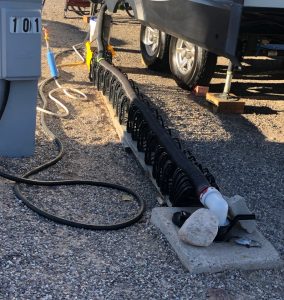
If you do, or are considering the possibilities, here’s a handy little device made specifically for this purpose.

The Valterra T1020-5VP Gray Water Drain Adapter.

We saw a camper in Ajo, Arizona using one. Just attach a garden hose and point it away from your rig. Downhill, of course.

If we’ve lost any sort of respect you had for us over this, we apologize. But I’m just coming clean with our reality. It’s just like a saying among scuba scuba enthusiasts:

There are two kinds of divers out there: Those who pee in their wetsuits, and those who lie about it.


Comments 32 Comments »

LinkWithin Related Stories Widget for Blogs


Banner