Posts Tagged “solar power”

Sand Creek Off Grid CabinI do love our mobile lifestyle, but it feels great to have a home base. Especially one with lots of room for our stuff, incredible views, and most importantly … unlimited running water and electricity!

Don’t get me wrong, I’m all for renewable energy and living off grid. But in the search for our perfect piece of paradise, we realized it just didn’t make sense to invest in a suitable solar array somewhere if we weren’t going to live there year-round. We did however consider a a few awesome off-grid properties …

Sand Creek Off Grid PropertyThe best of which was this fully self sufficient compound in the Sand Creek area of Northern Colorado. Which is a good thing, considering it is hours from anywhere and inaccessible year-round without a snowmobile.

The funny thing is, we first noticed this property for sale early in our trip during our first pass through Colorado. Returning to the area, we just had to check it out and see why it was still on the market. The realtor explained that everyone thinks it’s too remote. On the two-hour drive back to Fort Collins, via Wyoming, we agreed.

Sand Creek Geodesic Ranch PropertySince we were already way out there in Sand Creek, we decided to check out other properties.

These included a smelly mobile home with an old generator, and ranged from a remote cabin with no trees, no seclusion and no power, to this sprawling geodesic ranch home. It does have a robust power system, and it also has a huge barn, with a SnowCat inside.

Seeing the SnowCat was when we first started thinking twice about Sand Creek.

badger creek offgrid nightmare projectThe craziest decision we almost made, however, was thinking twice about this incredible piece of property in Badger Creek, CO, just east of Salida.

The terrain was amazing, as was the amount of work needed. Our RV solar system is more powerful than the one cobbled together at this place sometime in the 70s.

We considered vacant land too, where we could boondock for a couple months a year. But when we did the math, we realized we would probably end up with only a well and garage, all for the same price as our new comfy digs.

Another funny thing … a vacant piece of land we really loved is just up the hill from where I’m sitting, in my Dad’s recliner . . .  listening to my stereo, with the lights on . . . without a single worry about my solar system batteries.

Comments 3 Comments »

BLM Boondocking HWY 50 Salida, CONearly two years of keeping up this RV travel blog and it dawns on me that we’ve really only written this one boondocking tip, for conserving water.

Well, considering we have now gone as many as 45 days without hookups – not too recently, mind you – it seems appropriate to provide some tips for making the most of your boondocking days.

First, we refer to boondocking here as anytime we’re not hooked into the grid for the night. Ergo, any night spent without hookups is boondocking to us – whether it be out in the boonies or in a WalMart parking lot. Technically though, according to a “Disconnected RVing” article in the Escapees magazine we now get; if your staying in a campground without hookups, that is considered Dry Camping.

Lake Deweese RV Boondocking Westcliffe, CO

But this post isn’t about linguistics. It’s about seeing how long you can go without hookups, comfortably. And comfort is the key here. It takes a certain level of which to truly enjoy long term boondocking. Which we do, so keep that in mind as we share our methods, or madness depending on how you look at it …

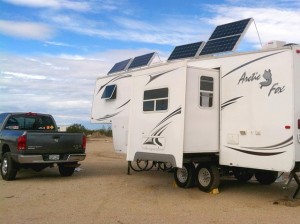
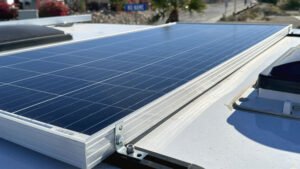
Go Solar – A basic system including solar panel, charge controller and inverter will help keep your batteries charged and provide AC power when not plugged in. As with anything of course, the more you spend the more you get. A large bank of 6v batteries and multiple solar panels may enable you to go longer before re-charging, if you have to at all. But this can quickly drain the pocketbook. We get by with one 120w solar panel, a 2400w inverter and the two 12v RV batteries that came with our trailer.

Stay Charged Up – To keep your batteries healthy, never let them drain completely. Many recommend charging batteries if they fall below 12 volts. Our inverter will automatically shut off if voltage drops below 11.7 volts. Get yourself an accurate voltmeter and run your generator to charge batteries as often as necessary.

Dry RV Battery Cells from NeglectMaintain those Batteriers – Be sure to check your batteries regularly. We learned the hard way. If they are not the sealed maintenance free type, keep distilled water on hand and top them off as necessary. Boondocking often means bumpy roads, so ensure all battery connections are tight, and no wires may be causing shorts in the system.

Use the Sun – Solar power is best suited for “float” charging which is basically keeping batteries topped off when they are about 90% charged. So take breaks during the day to let the sun do its work. A generator is better suited for “absorbtion” when battery power is further depleted. The best time to fully charge batteries with your generator is in the morning when they are at rest.

Consider Your Position – You know your rig. If you have solar panels, park so they get maximum exposure to the sun throughout the day. For us, it is best to park facing the northwest. That way our satellite dish will not cast a shadow on our solar panel.

Go in the Woods – Use vault toilets whenever available, or a tree if not, to conserve water from flushing.

Bundle up – In cold weather, put on a sweater or grab another blanket before considering wasting battery power and propane by running the furnace.

Strip Down – If it’s hot, put on your shorts or consider moving on to where it’s not. Your air conditioner will quickly drain your batteries, if your solar power system is capable of running it.

Stock Up – Before heading out to the Boonies, always ensure your fresh water tanks are full and you have plenty of gas for your generator and propane in your tanks. It helps to have empty waste water tanks too!

Stock Up Some More – Carry extra fresh water with you when planning extended stays without hookups. We use three collapsible 5 gallon water jugs and various other containers for topping off our tank.

Conserve – Sounds simple, but it is the most important thing to consider when boondocking. And it relates to both power and water. Use headlamps or battery powered lanterns rather than your house lights. Never leave lights on when not needed. We go so far as to remove the LP leak detector fuse so its LED light doesn’t glow.

save water while boondockingConserve More – Never let the water run when doing dishes. Clean pots and utensils using a bowl of soapy water then rinse all at once under dripping water. Using paper plates and disposable cups will eliminate the water needed to wash them. And remember, cast iron pans don’t need scrubbing and can usually just be wiped clean.

Conserve Even More – When taking a shower, run the water into a tea kettle or other container while it heats up so none is wasted. Take short bird baths with as little water as possible, or consider skipping daily showers. Use body wipes to stay feeling fresh.

Play The Shower Game – Try to see how little water you can actually use. Wet down within a few seconds. Soap up, then rinse off quickly. Shower immediately after one another so you don’t have to wait for the water from the faucet to warm up again.

Fill Your Black Tank – Grey water tanks often fill up quicker than your black water. So wash dishes using a tub and pour the dishwater down the toilet. Turn the water pump off when doing this so the toilet will not flush.

Make One Pot Meals – Plan meals you can make using one pan to reduce dish washing. We find that grilling uses the least amount of dishes and is much more enjoyable anyway.

Wipe Before Cleaning – Wipe out all dirty pans and dishes with a paper towel before washing to reduce the amount of water required.

Work Offline – Our biggest electrical draw is our network. With two laptops, a wireless router, MotoSat dish controller, HughesNet modem and network storage, we can drain our batteries within a few hours on a busy cloudy day. So, we do whatever work we can offline before booting up the network. Leaving the network drive unplugged helps, and once we are locked onto our satellite we also turn off the dish controller since there is no need for that again until we have to put the dish down.

Boondocking at WalMart in Elizabethtown North CarolinaEnjoy it – Boondocking is meant to be fun. It’s the best way to get out and away from it all. When your tanks are empty and full, and you need to recharge yourself, head for hookups to give the rig a good cleaning and enjoy the luxury of lights at night. Then dump and fill up so you can go do it again!

If you have any helpful off-grid RVing, “dry-camping” or boondocking tips of your own please share them by leaving a comment. And let us know how long you have gone without hookups or if you just abhor the idea.

Comments 15 Comments »

After giving us a tour of his garden, Joel explained how his electric car works.

The car was made by Jet Industries, a now defunct company from Austin, Texas, that was churning out electric cars during the 1970s oil crisis. Jet went bankrupt in 1982, just one year after newly-elected President Reagan decontrolled petroleum, declaring famously, “There’s plenty of oil!”

Comments 3 Comments »

LinkWithin Related Stories Widget for Blogs


Banner