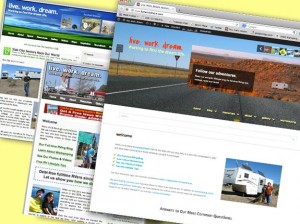
Here’s that informative post I promised before i got distracted by those great steaks and cocktails at the AA. I hope at least, that anyone who publishes an RV blog – or any website for that matter – will find this information, well… informative!
A while back, fellow Nü RVers those tech nomads informed us that a certain website was repurposing blog posts, not only from this site, but theirs and those of a number of other RVers.
Sure enough, a simple search revealed that entire posts of ours, including photos, were being republished in their entirely without our permission. Furthermore, we discovered that the site in question was a paid membership site, so it was using our content for profit!
The infringing website’s owner argued that because we make our posts available via rss feed, that the content was free to use as he wished. A bogus claim from someone who hadn’t done his homework, but a slightly grey area nonetheless.
TIP: To search a specific website for something you wrote, use Google and enter a distinct phrase followed by “site:” and the domain, like this…
Replace domain.com and the phrase or keywords to meet your needs.
While we were able to remove all existing and future content of ours from the website in question with one request, it got me thinking. I decided to do my own homework regarding the rights of web publishers, and gladly share what I found out here.
Ownership Rights of Web Content Publishers
According to the The Berne Copyright Convention, everything on the internet is considered copyrighted the moment it is written. Under the Berne Convention, copyright is automatic upon publication and does not require formal registration. When the United States joined the Convention in 1988, however, statutory damages and attorney’s fees continued to be available available only for registered works.
According to the World Intellectual Property Organization Copyright Treaty of 1996, “compilations of data or other material (databases), in any form, which by reason of the selection or arrangement of their contents constitute intellectual creations.” All blog content is stored in a database and is therefore an intellectual creation.
The Digital Millennium Copyright Act of 1998 (title 17, U. S. Code) states that “Copyright protection subsists, in accordance with this title, in original works of authorship fixed in any tangible medium of expression, now known or later developed, from which they can be perceived, reproduced, or otherwise communicated, either directly or with the aid of a machine or device.”
Finally, by republishing our copyrighted content on a for-profit website I confirmed that the infringing site was in violation of the federal copyright fair use doctrine, as described in sections 107 through 118 of the copyright law (title 17, U. S. Code)
Please note that I am by no means a lawyer, not even close, in any way. So I consulted one. I visited the free legal advice website LawGuru.com and asked:
What law can be cited when notifying someone who has republished original website content without permission, when they insist syndicated content (rss) is in the public domain?
My research proved me correct. Here is the answer I received:
You can cite 17 USC 106 which defines your exclusive rights, including a right of attribution, and 17 USC 501-506 which define your remedies. 505 authorizes recovery of attorneys fees and expenses and 506 may make it a criminal offense, particularly when done via the web.
However, you need to know that for the Court to have jurisdiction to enforce a copyright in the US, you must first apply to register it. It is a simple process for a copyright attorney to do that online. You should use an attorney, so that the attorney can simultaneously write a CDL (cease and desist letter) to this apparent infringer. A letter from you is not likely to have the same effect and not likely to be worded for optimum impact. In fact, most do-it-yourself non-lawyer CDLs are a disaster and some even create grounds for countersuit.
There are numerous blog aggregators on the interwebs that legally republish copyrighted content. They do this by only publishing an excerpt, assigning attribution, and including a link to the original source. But there may be times when one might wish to republish content from another source in its entirety, when it is appropriate to do so. Like when said person owns the copyright to the original content, or has explicit written permission to do so.
I’ve been considering doing just that with a new Tripawds Blog that will republish posts from our five featured blogs, giving readers one location to find all the best news, gear, gifts and nutrition advice for three legged dogs in one convenient site. Just how would I go about doing this?
To republish our own content and consolidate posts from multiple different blogs in one site, I plan to use the Autoblog plugin from WPMU Dev. Should you choose to do the same, of course, we know you’ll be certain you have the rights to do so.
My dad once told me a similar joke where an immigrant gave up on learning the English language after reading that headline. But yet again, I digress.
Though I have said it before, whenever I go AWOL around here you can rest assured it has something to do with three legged dogs. This time was a big deal.
Suffice it to say, however, that this undertaking was a crash course in php and css. And so far, it has paid off. Speaking figuratively, not literally. My prime directive for overhauling the Tripawds site was to improve performance in the discussion forums.
We started Tripawds using Mandigo, the same theme behind this blog and the RVblogz community. It has served us well. Mandigo is massively configurable, with lots of java and many files. Over the past few years, Jerry’s blog infrastructure had become bloated.
Too many hacks, scripts and widgets were bogging down the site.
It’s also where I got the lean and mean WPMU-Nelo. Hacking this slick WordPress theme to bits was relatively easy, even for me due to it’s code simplicity and parent/child theme structure.
Did someone say digress? We’re in Quartzite now with the Nü Crew, and I haven’t even written about Walla Walla. As much as I hate reading blogs that bemoan infrequent updates, we gots some catchin’ up to do!
Going seasonal certainly has put the trip into roadtrip. After a couple quick months in our new mountain home, it was exciting to get back on the road, but it’s kinda weird to have settled right back down here at The Desert Rose while René is doing her time at Amazon. We are nowhere warm yet, so I wouldn’t say we quite qualify for true snowbird status yet. Leaving the house behind, however, officially signifies Phase II of our journey.
I’m just happy I didn’t have to manually design this map. While my search for a WordPress visited states map widget for RVers ended with me wondering if I’m the only out there who thinks such a plugin would be really cool, I did come across a couple websites for automatically generating colorful RVer maps of visited states ready for use on any website!
So, 36 states down, only 14 to go – though I’m not sure how we’re getting the rig to Hawaii. Aside from leaving the mainland, and navigating a few congested New England states, we can now say we have been just about everywhere, except the middle. Well, that’s what this whole phase II thing is all about, or perhaps Phases III and IV. Now that we have a home base, what’s the hurry?
You haven’t heard from me around here in a while because I have been a bit preoccupied lately. In addition to our property search, home purchase, cross country move, and welcoming Wyatt into our pack, I have been buried with PHP, MySQL queries, FTP sessions and function calls.
Say what, you say? It’s been quite a learning experience really, which I care to share in depth someday. But for now, I’ll just tell you what it means…
We just completed our migration of Tripawds to the WordPress MU platform, but RVblogz was my first WPMU installation. You say what again? Basically, it means we are now offering free blogs for tripawd lovers and full-time RVers.
Yes, we announced RVblogz a long time ago, but the recent migration to WPMU has enabled us expedite blog creation and offer much more robust features for RVbloggerz. In fact you can get your own free travel blog in seconds, now that we have automated the blog creation process. Well, WordPress MU has, but we made it work!
If you want to check out a fine example of how full-timers are using RVblogz, check out the Purcells On Wheels traveling family blog! Or, how many of you have heard of the Killbarney project?
Rebuilding the Tripawds community has been exciting, as Jerry’s discussion forum members have grown to 800 strong. Now they can all have their own three legged dog blogs. And with the RVblogz Communities feature, members can create their own mini-facebook, all about RVing. OK, well maybe not. But in addition to easily publishing a travel blog with over 100 themes to choose from, you can create your own little RV community with a message board, Wiki pages, and news items.
So much to tell, such little time … just wanted any readers we have left to know why I’ve been such a stranger lately. And now that we’re headed back to ranch so I can work the Vickers hay harvest, I may become even stranger yet. If that is at all possible.
If you’re seeing this post, then we have successfully migrated to our own dedicated server. You may not be since DNS changes can take some time to propagate throughout the world, but I digress.
So, Bob is provisioning our new dedicated server. Soon I get to learn cPanel and endure the WordPress migration thing for the tripawd blog and move the Simple:Press forums. That means this site will follow. Expect downtime over the upcoming week. Thank you for your continued support.
For inquiring minds who want to know, here’s an exchange I had a while back with one such interested party who has valid concerns about blog spam. I replied with what I feel are the primary benefits of running our own installation of WordPress.
… any advice you could offer on running your own instance of WordPress rather than setting your blog up at xxx.wordpress.com … WordPress offers cautions about the potential problems with spambots posting to blogs, and note they have a variety of things in place to prevent this.
I’m wondering how much of a problem you folks have found this, and what provisions you may have had to take to secure your own blog against illegitimate postings and other intrusions?
My Reply: The “Akismet” anti-spam WordPress plugin that comes with a standard installation of WordPress catches the majority of spam comments received through our blogs. Periodically some will get through, but by configuring our blogs to require moderation of first-time comments, we can easily “spam” them without them ever appearing on the site.
We also use the WP-Deadbolt plugin which lets us blacklist specific domains from attempting to register for our blogs. This also greatly reduces the potential for comments from known spammers.
In all, spam is not an issue for us, and we have our four blogs running on our own WP installations. Management and moderation of spam must take us less than an hour a month.
The major difference between installing your own WordPress.org blog, and having a WordPress.com blog – aside from the custom domain issue – is flexibility. At xxx.wordpress.com, you cannot install plugins or customize the code behind your blog.
With your own installation you can hack away to your heart’s content and tweak the code to customize functionality and appearance however you see fit. This does however, require additional time and technical ability.
Here are just a few links that discuss the pros and cons in more detail. Hope this helps at last somebody out there!
If you’re a blogger, each time you finish writing a post and are about to Publish, you might think to yourself “is anyone actually reading this? Does anyone really care about what I might have to say?”
For more than 18 months Jim and I have used this blog to document and share our crazy full-time RVing sabbatical adventure. We are faithful about checking our visitor statistics and click-thru commissions, but we never felt like we had a good handle on you—our visitors: why you come here, and what you like or don’t like about what we publish.
We’ve often wondered what site features or blog topics we should put more time and effort into, and considered what might we scrap altogether.
To put aside any doubts we had about our work, we published our Reader Survey back in November. We used a WordPress plug-in called CForms II. Many thanks to everyone who submitted a survey.
We were intrigued with what we discovered. Among many of the findings, we learned new things like:
Discovery #1: More people read our blog on a weekly basis than daily.
The Conclusion:Many of you are busy and choose to catch up with our posts all at once, perhaps skipping through them until you find a topic that interests you. Perhaps we should also post no more than say, three posts a week so you don’t feel overwhelmed when you do visit.
Discovery #2: You’re into the way we live.
The top 3 blog categories people like to read about on our site are: “Fulltiming,” “Simple Living” and “RV Technology”
The Conclusion:Our core readers are interested in what it’s like to live a simple life in an RV on a fulltime basis while remaining connected. We are happy knowing that we’ve been writing for the things you want to know more about.
Discovery #3: If you subscribe, you don’t visit often. And vice versa.
Instead of subscribing to our blog in an RSS Reader, and perusing posts directly within that – a Reader is like an electronic newspaper of your own, which gathers up all of the latest work by the blogs and websites that you’ve told it to monitor – most of our audience physically comes back to our site each time they want to read it.
The Conclusion: Wow, we get bookmarked and people actually remember to visit at least once a week. This is a huge compliment. Also, while we didn’t ask your ages, this leads us to believe that the majority of our readers might not have the desire or time to get comfortable with how to use RSS feeds. If this is the case, and you want a quick tutorial on how to use a Reader, let us know and we’ll write about it.
Side Note: Of those readers who replied to our survey, that is! Feedburner stats indicate we have had on average 113 subscribers over the past 30 days. Thirty four readers completed our survey.
Discovery #4: You don’t Digg us.
Based on your feedback, social networking isn’t something you’re doing. Most of you don’t Twitter, and you definitely don’t spend a lot of time using the social bookmarking toolbars at the conclusion of each of our blog posts either. (In a social bookmarking system, users save links to web pages that they want to remember and share with specified people or groups inside certain online “networks.”)
Discovery #5: Most readers find our monthly expense reports to be useful.
The Conclusion: Our readers are curious about what it costs to live the way we do, and are perhaps comparing our spending against theirs. For the foreseeable future, I guess I’m stuck playing beancounter at the end of each month.
The Conclusion:Again, we think that this is a reflection of our readers’ age bracket. It was good to learn this about them, because as more social networking plug-ins become available for us to add to our site, we know that this probably isn’t something we should spend a lot of time implementing.
FYI: The “share” links now include a “print” and “email to a friend” buttons.
Discovery #6: Our closest friends and family don’t care.
Almost none of our friends and family filled out the survey. Some readers who comment frequently opted out as well. The most enthusiastic respondents who enjoy our site, are total strangers who never comment.
The Conclusion: Our friends and family know how boring we really are and don’t buy into that road tripping, freewheelin’ hippie image we have on the web.
Overall …
It seems that you are here for the blog itself, not really for the rest of the website, which includes a storefront and a road trip soundtrack page, if you didn’t already know. The number one reason you tune in is to read about what life on the road is really like, and where the best places in this country are for people with like-minded ways of thinking.
Thanks to the generous readers who gave their time to fill out the survey, we are now confident that for the most part, our writing is on the right track. While some things can be omitted or cleaned up (like not talking about politics, according to a few respondents), you have affirmed that our approach is working well.
And if we are way off base or totally full of crap with this analysis, please let us know with a comment below.
OK, so far so good with our upgrade to WordPress 2.7. No fatal PHP errors or major incompatibility catastrophes. This is a good thing.
But we haven’t yet upgraded the theme which is probably why your saying, “What’s the big difference?” But with so many hard-coded theme template modifications, I may not upgrade Mandigo anytime soon. The new version does have some pretty cool new features, but I think I’ll just quit while I’m ahead here and get to work on Jerry’s site to see what can of worms I can open with the Discussion Forums upgrade.
The only other change you may notice – if you ever used it – is the missing “Email this Post” feature. Well, the WP-Email plugin didn’t play nice after the upgrade so we’ve eliminated it. No worries though, the new Sociable plugin lets you email this post using the first “Share This Link” icon below.
Please let us know if you experience any new technical difficulties, or if your subscription feed no longer works. But then, I guess you’d never get this if it didn’t!